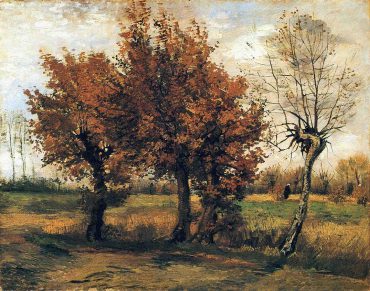
Vincent Van Gogh, Autumn Landscape with Four Trees, 1885
I.
Fiato d’autunno, o Ponente selvaggio
Ch’urgi le foglie come ombre fuggenti
Da un mago, all’invisibil tuo passaggio,
Gialle, rossomalate, pestilenti
Turbe; e ciascuna alla sua buia cella
Invernal trai le aligere sementi,
Ove la fredda terra le suggella,
Come la tomba i corpi, fin che appena
L’azzurra tua primaveril sorella
Soffia la tromba, fa la terra amena
D’odori, e i germi al suon de’ dolci modi
A pascer l’aria come greggi mena:
Spirto selvaggio, che per tutto godi
In serbare e distrugger, m’odi, oh, m’odi!
II.
Tu, fiume dove nuotan nubi a schiere,
Che Cielo e Mare han scosso come fronda
Dai rami lor conserti, messaggere
Di piogge e lampi: — effusi son sull’onda
Tua d’aria azzurra, qual fulgente crine
Irto sul capo d’Evia furibonda,
Al pien colmo del cielo dal confine
D’orizzonte, i capei della Bufera
Che s’approssima; — o pianto sulla fine
Dell’Anno, a cui questa postrema sera
Volta d’ampio sepolcro sia, che annodi
Coi congesti vapor dell’atmosfera,
Fin che da quel pregno aer pioggia esplodi
Nera, con fuoco e con gragnola, oh, m’odi!
III.
Tu che il turchin Mediterraneo senti
Per te destarsi, ove in sua calma estiva
Si culla al suon di vitrëe correnti,
Nel sen di Baia, alla pumicea riva
D’un’isola; ed antiche regge e torri
Nella luce dell’onde ch’è più viva
Vedeva in sonno ei tremolar, d’azzurri
Muschi e fiori ineffabili coperte;
O tu per cui l’Atlantico ove corri
Si fende in gorghi, mentre giù l’inerte
Selva del mare di limosi biodi
Per lo spavento il suo color converte
D’un tratto, a udir le note tue melodi,
E trema e si dischioma, m’odi, oh, m’odi!
IV.
Oh, foss’io foglia dal tuo soffio mossa,
Volassi io teco, nube senza pondo;
Flutto, fremessi sotto la tua possa!
Parte avess’io nell’impeto, secondo
In libertà, o indomito, a te solo!
Foss’io compagno al tuo vagar sul mondo
Come da bimbo, allor quando il tuo volo
Vincer pareva agevole salita!
Non mai così pregato avrei nel duolo,
Levando a te la voce mia smarrita!
Alzami, foglia, nube, onda leggera!
Sanguino sulle spine della vita!
Curva dall’ore gravi e prigioniera
È un’anima tua pari, indoma, altiera.
V.
Fammi tua cetra al par del bosco, o Vento!
Che fa, se cadon pur le foglie mie?
Forte, autunnal, mesto e pur dolce accento
Da noi trarran le tue fiere armonie.
Che il mio spirito sia nel tuo converso!
O gagliardo, sii me! Per tutte vie
Reca mie morte idee sull’universo
Come le foglie, a vite suscitare
Nuove! E con la magia di questo verso,
Faville d’inestinto focolare,
Le mie parole fra le genti trai!
Tromba di profezia sii da destare
La terra, ne’ miei labbri. Chè s’è omai
Verno, tardar può Primavera assai?
Percy Bysshe Shelley
(Traduzione di Mario Praz)
da “Poeti inglesi dell’ottocento”, Casa Editrice Marzocco, Firenze, 1925
∗∗∗
Ode to the West Wind
I.
O Wild West Wind, thou breath of Autumn’s being
Thou from whose unseen presence the leaves dead
Are driven like ghosts from an enchanter fleeing,
Yellow, and black, and pale, and hectic red,
Pestilence-stricken multitudes! O thou
Who chariotest to their dark wintry bed
The winged seeds, where they lie cold and low,
Each like a corpse within its grave, until
Thine azure sister of the Spring shall blow
Her clarion o’er the dreaming earth, and fill
(Driving sweet buds like flocks to feed in air)
With living hues and odours plain and hill;
Wild Spirit, which art moving everywhere;
Destroyer and preserver; hear, O hear!
II.
Thou on whose stream, ‘mid the steep sky’s commotion,
Loose clouds like earth’s decaying leaves are shed,
Shook from the tangled boughs of heaven and ocean,
Angels of rain and lightning! there are spread
On the blue surface of thine airy surge,
Like the bright hair uplifted from the head
Of some fierce Mænad, even from the dim verge
Of the horizon to the zenith’s height,
The locks of the approaching storm. Thou dirge
Of the dying year, to which this closing night
Will be the dome of a vast sepulchre,
Vaulted with all thy congregated might
Of vapours, from whose solid atmosphere
Black rain, and fire, and hail, will burst: O hear!
III.
Thou who didst waken from his summer dreams
The blue Mediterranean, where he lay,
Lulled by the coil of his crystalline streams,
Beside a pumice isle in Baiæ’s bay,
And saw in sleep old palaces and towers
Quivering within the wave’s intenser day,
All overgrown with azure moss, and flowers
So sweet, the sense faints picturing them! Thou
For whose path the Atlantic’s level powers
Cleave themselves into chasms, while far below
The sea-blooms and the oozy woods which wear
The sapless foliage of the ocean, know
Thy voice, and suddenly grow gray with fear,
And tremble and despoil themselves: O hear!
IV.
If I were a dead leaf thou mightest bear;
If I were a swift cloud to fly with thee;
A wave to pant beneath thy power, and share
The impulse of thy strength, only less free
Than thou, O uncontrollable! if even
I were as in my boyhood, and could be
The comrade of thy wanderings over heaven,
As then, when to outstrip thy skiey speed
Scarce seem’d a vision—I would ne’er have striven
As thus with thee in prayer in my sore need.
O! lift me as a wave, a leaf, a cloud!
I fall upon the thorns of life! I bleed!
A heavy weight of hours has chain’d and bow’d
One too like thee—tameless, and swift, and proud.
V.
Make me thy lyre, even as the forest is:
What if my leaves are falling like its own?
The tumult of thy mighty harmonies
Will take from both a deep autumnal tone,
Sweet though in sadness. Be thou, Spirit fierce,
My spirit! Be thou me, impetuous one!
Drive my dead thoughts over the universe,
Like wither’d leaves, to quicken a new birth;
And, by the incantation of this verse,
Scatter, as from an unextinguish’d hearth
Ashes and sparks, my words among mankind!
Be through my lips to unawaken’d earth
The trumpet of a prophecy! O Wind,
If Winter comes, can Spring be far behind?
Percy Bysshe Shelley
da “The poetical works of Percy Bysshe Shelley”, A. & W. Galignani, 1841






 Poesia in rete