Un’avventura – Louise Glück

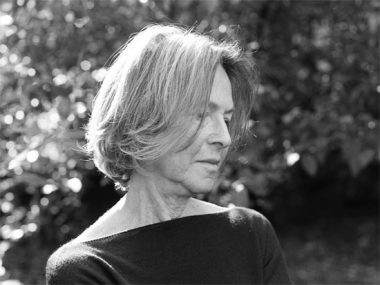
Louise Glück

1.

Una notte quando stavo per addormentarmi mi è venuto in mente
che avevo finito con quelle avventure amorose
di cui ero stata a lungo schiava. Finito con amore?
il mio cuore sussurrò. Gli ho risposto che molte scoperte profonde
ci aspettavano, sperando, allo stesso tempo, che non mi venisse chiesto
di nominarle. Perché non potevo nominarle. Ma la convinzione che esistessero –
questo contava sicuramente qualcosa?

2.

La notte successiva ha avuto lo stesso pensiero,
questa volta riguardo alla poesia, e nelle notti che seguirono
varie altre passioni e sensazioni erano, allo stesso modo,
messe da parte per sempre, e ogni notte il mio cuore
protestava contro il suo futuro, come un bambino privato del giocattolo preferito.
Ma questi addii, ho detto, sono il modo in cui vanno le cose.
E ancora una volta ho accennato al vasto territorio
che ci si apre ad ogni commiato. E con quella frase sono diventata
un glorioso cavaliere che cavalca nel sole al tramonto e il mio cuore
divenne un destriero sotto di me.

3.

Stavo, capirai, entrando nel regno della morte,
pur non sapendo dire perché questo paesaggio
fosse così convenzionale. Anche qui le giornate erano lunghissime
mentre gli anni erano stati brevissimi. Il sole tramontò sulla montagna lontana.
Le stelle brillavano, la luna cresceva e calava. Presto
mi sono apparsi i volti del passato:
mia madre e mio padre, la mia sorellina; non avevano, sembrava,
finito quello che avevano da dire, mentre ora
li sentivo perché il mio cuore era fermo.

4.

A questo punto, ho raggiunto il precipizio
ma il sentiero, ho visto, non scendeva dall’altra parte;
piuttosto, essendosi appiattito, continuava a questa quota
a perdita d’occhio, anche se gradualmente
la montagna che lo sosteneva si dissolse completamente
così che mi ritrovai a cavalcare costantemente nell’aria –
Tutt’intorno, i morti mi incoraggiavano, la gioia di trovarli
cancellata dal compito di rispondere loro –

5.

Poiché tutti insieme eravamo prima carne,
ora eravamo nebbia.
Come prima eravamo oggetti con le ombre,
ora eravamo sostanza senza forma, come sostanze chimiche evaporate.
Neigh, neigh¹, ha detto il mio cuore,
o forse no, no: era difficile saperlo.

6.

Qui la visione è finita. Ero nel mio letto, il sole del mattino
sorgeva felice, la trapunta di piume
ammucchiata in cumuli bianchi sulla parte inferiore del mio corpo.
Eri stato con me –
c’era un’ammaccatura nella seconda federa.
Eravamo scampati alla morte –
o questa era la vista dal precipizio?

Louise Glück

(TRADUZIONE DI MARCELLO COMITINI)
¹Nitrisco, nitrisco
ALTRE POESIE DI LOUISE GLÜCK TRADOTTE DA MARCELLO COMITINI

∗∗∗

An adventure

1.

It came to me one night as I was falling asleep
that I had finished with those amorous adventures
to which I had long been a slave. Finished with love?
my heart murmured. To which I responded that many profound discoveries
awaited us, hoping, at the same time, I would not be asked
to name them. For I could not name them. But the belief that they existed—
surely this counted for something?

2.

The next night brought the same thought,
this time concerning poetry, and in the nights that followed
various other passions and sensations were, in the same way,
set aside forever, and each night my heart
protested its future, like a small child being deprived of a favorite toy.
But these farewells, I said, are the way of things.
And once more I alluded to the vast territory
opening to us with each valediction. And with that phrase I became
a glorious knight riding into the setting sun, and my heart
became the steed underneath me.

3.

I was, you will understand, entering the kingdom of death,
though why this landscape was so conventional
I could not say. Here, too, the days were very long
while the years were very short. The sun sank over the far mountain.
The stars shone, the moon waxed and waned. Soon
faces from the past appeared to me:
my mother and father, my infant sister; they had not, it seemed,
finished what they had to say, though now
I could hear them because my heart was still.

4.

At this point, I attained the precipice
but the trail did not, I saw, descend on the other side;
rather, having flattened out, it continued at this altitude
as far as the eye could see, though gradually
the mountain that supported it completely dissolved
so that I found myself riding steadily through the air—
All around, the dead were cheering me on, the joy of finding them
obliterated by the task of responding to them—

5.

As we had all been flesh together,
now we were mist.
As we had been before objects with shadows,
now we were substance without form, like evaporated chemicals.
Neigh, neigh, said my heart,
or perhaps nay, nay—it was hard to know.

6.

Here the vision ended. I was in my bed, the morning sun
contentedly rising, the feather comforter
mounded in white drifts over my lower body.
You had been with me—
there was a dent in the second pillowcase.
We had escaped from death—
or was this the view from the precipice?

Louise Glück

da “Faithful and Virtuous Night”, Farrar, Straus and Giroux, 2014

Attenzione – Philip Schultz

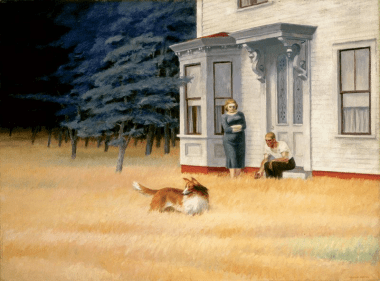
Edward Hopper, Cape Cod Evening, 1939


Il più delle volte mia moglie ne merita più
di quanta gliene possa dare, un atto di equilibrio
su quando essere visibile, data l’importanza di lei
nella nostra vita complessa. I miei figli, crescendo,
ne hanno meno bisogno, uno sempre meno dell’altro.
Gli amici, invecchiando, ne hanno più bisogno.
Specialmente i morti. Il nostro cane, anche mentre dorme,
ne vuole un po’, chiama con la coda. La casa,
più gliene diamo, più ne vuole. Le pareti hanno bisogno
di essere ringraziate per la loro pazienza e lealtà,
i pavimenti perché sostengono il peso della nostra indifferenza.
Io cerco di non sentirmi troppo in colpa con i miei studenti.
La colpa è essenziale nel nostro rapporto, colpa,
ostinazione e una buona dose di calma. Le mie poesie
saccheggiano quasi tutto, timori, progetti,
congetture e stupori, cercano prove
di infedeltà, frammenti di ispirazione. Indifferenti alla
sofferenza che descrivono, odiano tutto quello
che amo, credono solo nella loro insularità. La mia
carriera, prima quasi inesistente, non ne ha mai
richiesta molta. Ora, sotto forma di lettere,
email, telefonate, non mi permette di dimenticare che esiste,
una nuova amica il cui unico scopo è di mostrarsi
inevitabile. C’è la nostra città, la sua politica, scandali
e impegni, e tutti i bei privilegi ineludibili
della cittadinanza, un’idea che nessuno più comprende.
E poi le guerre, naturalmente, coi loro soliti eccessi
graffianti ipocriti ingigantiti. E c’è anche
la mia felicità, la sua testarda perversa fragilità
che cerca di non farsi notare. A volte
a notte fonda ci abbandoniamo ai ricordi, io e la mia felicità,
nemici di una vita che si godono la reciproca compagnia.

Philip Schultz

(Traduzione di Paola Splendore, con la collaborazione di Maria Baiocchi, Barbara Fiore e Sandro Triulzi)

da “Il dio della solitudine”, a cura di Paola Splendore, Donzelli Poesia, 2018

∗∗∗

Attention

More often than not, my wife deserves more
than I can give her, a balancing act of knowing
when to be visible, given her importance
to our complexity. My sons need less as they
grow older, one always less than the other.
My friends need more as they grow older.
The dead ones, especially. Even while asleep,
our dog needs some, tail beckoning. The more
our house gets, the more it needs. The walls
need to be thanked for their loyalty and patience,
the floors for suffering the weight of our indifference.
I try not to feel too bad about my students.
Guilt is essential to our relationship, guilt,
persistence and a great serenity. My poems
poach nearly everything, my fears, schemes,
conjectures and astonishments, after evidence
of infidelity, scraps of inspiration. Indifferent to
the suffering they describe, they dislike everything
I love, believe only in their insularity. Because
I never really had one before, my career never
used to ask for much. Now, disguised as letters,
emails, phone calls, it never lets me forget it’s there,
a new best friend whose only purpose is to prove
its inevitability. There’s our town, its politics, scandals
and obligations, and all the fine, inescapable privileges
of citizenship in an idea no one understands anymore.
And, yes, the wars, of course, their constant scraping
fork-tongued self-aggrandizing exaggerations. Also,
my happiness, its stubborn, perverse vulnerability
that tries not to call attention to itself. Sometimes,
late at night, we, my happiness and I, reminisce,
lifelong antagonists enjoying each other’s company.

Philip Schultz

da “The God of Loneliness. Selected and New Poems”, Houghton Mifflin Harcourt, 2010

Lady Lazarus – Sylvia Plath

Eve Arnold, Marlene Dietrich at Columbia Records recording Studio, New York, 1952


L’ho rifatto.
Un anno ogni dieci
mi riesce —

una specie di miracolo ambulante, la mia pelle
splendente come un paralume nazista,
il piede destro

un fermacarte,
il viso, anonima e fine
tela ebraica.

Solleva il panno,
o mio nemico.
Incuto terrore? —

Il naso, le occhiaie vuote, tutti i denti?
L’alito puzzolente
svanirà in un giorno.

Presto, presto la carne
che il severo sepolcro ha divorato
tornerà al suo posto su di me,

e sarò una donna sorridente.
Ho trent’anni soltanto.
E come i gatti ho nove volte per morire.

Questa è la Numero Tre.
Quanto ciarpame
da annientare ogni decennio,

che miriade di filamenti.
La folla che sgranocchia noccioline
spintona per vedere

mentre vengo sbendata mani e piedi —
il grande spogliarello.
Signori e signore,

ecco qua le mie mani,
le ginocchia.
Sarò pure pelle e ossa,

ma sono sempre la stessa identica donna.
La prima volta avevo dieci anni.
Fu un incidente.

La seconda volevo
andare fino in fondo senza ritorno.
Cullandomi mi chiusi

come una conchiglia.
Dovettero chiamare e chiamare
e staccarmi di dosso i vermi come perle appiccicose.

Morire
è un’arte, come qualunque altra cosa.
Io lo faccio in modo magistrale,

lo faccio che fa un effetto da impazzire
lo faccio che fa un effetto vero.
Potreste dire che ho la vocazione.

È facile farlo in una cella.
È facile farlo e rimanerci.
È il teatrale

ritorno in scena in pieno giorno,
stesso posto, stessa faccia, stesso bestiale
urlo goduto:

«Miracolo!»
è questo che mi stende.
Si paga

per vedere le mie cicatrici, si paga
per ascoltarmi il cuore —
funziona eccome.

E si paga, si paga salato
per sentire una parola, per toccare,
per un goccio di sangue,

una ciocca di capelli, un brandello di veste.
E così, Herr Doktor,
e così, Herr Nemico.

Sono il tuo capolavoro,
il tuo bene prezioso,
l’infante d’oro puro

che si scioglie in un grido.
Mi rigiro e brucio.
Non credere che sottovalutati le tue sollecite cure.

Cenere, cenere —
Frughi e rimesti.
Carne, ossa, non ci sono resti —

una saponetta,
una vera nuziale,
una capsula dentaria.

Herr Dio, Herr Lucifero
in guardia
in guardia.

Dalla cenere
sorgo con i miei capelli rossi
e divoro gli uomini come aria.

Sylvia Plath

23-29 ottobre 1962

(Traduzione di Anna Ravano)

da “Ariel”, in “I capolavori di Sylvia Plath”, 2004

***

Lady Lazarus

I have done it again.
One year in every ten
I manage it—

A sort of walking miracle, my skin
Bright as a Nazi lampshade,
My right foot

A paperweight,
My face a featureless, fine
Jew linen.

Peel off the napkin
O my enemy.
Do I terrify?—

The nose, the eye pits, the full set of teeth?
The sour breath
Will vanish in a day.

Soon, soon the flesh
The grave cave ate will be
At home on me

And I a smiling woman.
I am only thirty.
And like the cat I have nine times to die.

This is Number Three.
What a trash
To annihilate each decade.

What a million filaments.
The peanut-crunching crowd
Shoves in to see

Them unwrap me hand and foot—
The big strip tease.
Gentlemen, ladies

These are my hands
My knees.
I may be skin and bone,

Nevertheless, I am the same, identical woman.
The first time it happened I was ten.
It was an accident.

The second time I meant
To last it out and not come back at all.
I rocked shut

As a seashell.
They had to call and call
And pick the worms off me like sticky pearls.

Dying
Is an art, like everything else.
I do it exceptionally well.

I do it so it feels like hell.
I do it so it feels real.
I guess you could say I’ve a call.

It’s easy enough to do it in a cell.
It’s easy enough to do it and stay put.
It’s the theatrical

Comeback in broad day
To the same place, the same face, the same brute
Amused shout:

‘A miracle!’
That knocks me out.
There is a charge

For the eyeing of my scars, there is a charge
For the hearing of my heart—
It really goes.

And there is a charge, a very large charge
For a word or a touch
Or a bit of blood

Or a piece of my hair or my clothes.
So, so, Herr Doktor.
So, Herr Enemy.

I am your opus,
I am your valuable,
The pure gold baby

That melts to a shriek.
I turn and burn.
Do not think I underestimate your great concern.

Ash, ash—
You poke and stir.
Flesh, bone, there is nothing there—

A cake of soap,
A wedding ring,
A gold filling.

Herr God, Herr Lucifer
Beware
Beware.

Out of the ash
I rise with my red hair
And I eat men like air.

Sylvia Plath

23-29 October 1962

da “Ariel”, London, Faber and Faber, 1965

Musica proibita – Louise Glück

Dipinto di Antonio Possenti


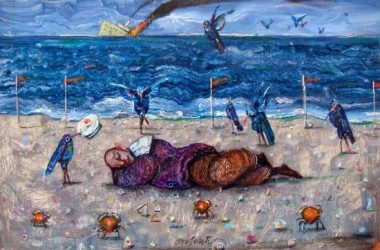
Dopo che l’orchestra ebbe suonato per un po’, ed erano stati eseguiti l’andante, lo scherzo, il poco adagio¹, e il primo flautista aveva poggiato la testa sul leggìo perché non sarebbe servito fino a domani, arrivò un passaggio che si chiamava musica proibita perché non poteva, precisò il compositore, essere suonato. E ancora deve esistere ed essere superato, un intervallo² a discrezione del direttore d’orchestra. Ma stasera, il direttore d’orchestra decide, bisogna suonarlo — ha fame di farsi un nome. Il flautista si sveglia di soprassalto. È successo qualcosa alle sue orecchie, qualcosa che non aveva mai provato prima. Il suo sonno è finito. Dove sono adesso, pensa. E poi l’ha ripetuto, come un vecchio disteso per terra invece che nel suo letto. Dove sono adesso?

Louise Glück

(TRADUZIONE DI MARCELLO COMITINI)
¹ in italiano nel testo
² intervallo è detta la differenza di “altezza” tra due suoni
                                                                                                             [N.d.T]
ALTRE POESIE DI LOUISE GLÜCK TRADOTTE DA MARCELLO COMITINI

∗∗∗

Forbidden music

After the orchestra had been playing for some time, and had passed the andante, the scherzo, the poco adagio, and the first flautist had put his head on the stand because he would not be needed until tomorrow, there came a passage that was called the forbidden music because it could not, the composer specified, be played. And still it must exist and be passed over, an interval at the discretion of the conductor. But tonight, the conductor decides, it must be played—he has a hunger to make his name. The flautist wakes with a start. Something has happened to his ears, something he has never felt before. His sleep is over. Where am I now, he thinks. And then he repeated it, like an old man lying on the floor instead of in his bed. Where am I now?

Louise Glück

da “Faithful and Virtuous Night”, Farrar, Straus and Giroux, 2014
Corrente – William Carlos Williams

Dipinto di Odilon Redon


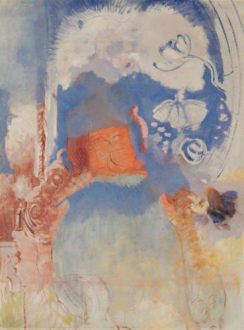
Hai l’incanto d’un fiume
sotto cieli tranquilli.
Ci sono cose imperfette
ma vi si stende una musica.

E dice per che letto
di tenebre si spinge la corrente
a che smagliante mare
che increspa la mia mente.

William Carlos Williams

(Traduzione di Vittorio Sereni)

da “William Carlos Williams, Poesie”, “Supercoralli” Einaudi, 1967

∗∗∗

A flowing river 

You are lovely as a river
under tranquil skies –
There are imperfections
but a music overlays them –

telling by how dark a bed
the current moves
to what sea that shines
and ripples in my thought

William Carlos Williams

da “Collected Later Poems”, New Directions, 1951