Come uno buttato ubriaco sul battello postale – John Ashbery

John Ashbery


Ho tentato tutto, poco era immortale e libero.
Altrove è come stessimo in un luogo dove il sole
scende sfarinato, un po’ per volta,
ad aspettare che qualcuno venga. Volano parole aspre,
mentre il sole tinge in giallo il verde dell’acero…

Tutto qui, ma ermeticamente
ho avvertito il sommuoversi di un fiato nuovo nelle pagine
che tutto inverno hanno esalato l’odore di un vecchio catalogo.
Nuovi periodi si accendevano. Ma l’estate
era inoltrata, non ancora oltre il mezzo del cammino
ma piena e buia della promessa di quella pienezza,
di quel momento in cui non ci si può più sviare
e perfino i meno attenti ammutoliscono
per contemplare ciò che è pronto ad accadere.

Uno sguardo di specchio ti arresta
e tu passi oltre scosso: ero io il percepito?
Mi hanno notato, stavolta, così come sono,
o tutto è ancora rimandato? I bimbi
ancora intenti ai giochi, nuvole che salgono con agile
impazienza nel cielo pomeridiano, per dissiparsi
quando scende il limpido, denso crepuscolo.
Solo in quel colpo di clacson
là in fondo, per un attimo, ho pensato
che l’insigne evento formale stesse iniziando, orchestrato,
i colori addensati in uno sguardo, ballata
che abbraccia il mondo intero, adesso, ma con dolcezza,
ancora con dolcezza, ma con ampia autorità e tatto.

La prevalenza di quei fiocchi grigi che cadono?
È pulviscolo di sole. Hai dormito al sole
più della sfinge, ma non ne sai più di prima.
Entra. Ho pensato che un’ombra tagliasse la soglia
ma era soltanto lei venuta a chiedere ancora una volta
se intendevo entrare, e in caso contrario di prendermela calma.
La lucentezza della notte s’insedia. Una luna dal pallore cistercense
ha scalato la vetta del firmamento, vi si è installata,
socia adesso nell’affare del buio.
E un sospiro sale da ogni minuscola cosa terrena,
da libri, carte, vecchie giarrettiere, dai bottoni di sottomaglie e mutandoni
riposti in una scatola di cartone bianco chissà dove, e tutte le versioni
inferiori di città rase al suolo dalla livella della notte.
L’estate troppo esige, troppo prende,
ma la notte, schiva, reticente, dona più di ciò che sottrae.

John Ashbery

(Traduzione di Damiano Abeni)

da “Autoritratto entro uno specchio convesso”, Bompiani, 2019

∗∗∗

As one put drunk into the packet-boat

I tried each thing, only some were immortal and free.
Elsewhere we are as sitting in a place where sunlight
Filters down, a little at a time,
Waiting for someone to come. Harsh words are spoken,
As the sun yellows the green of the maple tree…

So this was all, but obscurely
I felt the stirrings of new breath in the pages
Which all winter long had smelled like an old catalogue.
New sentences were starting up. But the summer
Was well along, not yet past the mid-point
But full and dark with the promise of that fullness,
That time when one can no longer wander away
And even the least attentive fall silent
To watch the thing that is prepared to happen.

A look of glass stops you
And you walk on shaken: was I the perceived?
Did they notice me, this time, as I am,
Or is it postponed again? The children
Still at their games, clouds that arise with a swift
Impatience in the afternoon sky, then dissipate
As limpid, dense twilight comes.
Only in that tooting of a horn
Down there, for a moment, I thought
The great, formal affair was beginning, orchestrated,
Its colors concentrated in a glance, a ballade
That takes in the whole world, now, but lightly,
Still lightly, but with wide authority and tact.

The prevalence of those gray flakes falling?
They are sun motes. You have slept in the sun
Longer than the sphinx, and are none the wiser for it.
Come in. And I thought a shadow fell across the door
But it was only her come to ask once more
If I was coming in, and not to hurry in case I wasn’t.

The night sheen takes over. A moon of cistercian pallor
Has climbed to the center of heaven, installed,
Finally involved with the business of darkness.
And a sigh heaves from all the small things on earth,
The books, the papers, the old garters and union-suit buttons
Kept in a white cardboard box somewhere, and all the lower
Versions of cities flattened under the equalizing night.
The summer demands and takes away too much,
But night, the reserved, the reticent, gives more than it takes.

John Ashbery

da “Self-Portrait in a Convex Mirror”, Penguin Publishing Group, 1972

Paesaggio natìo – Louise Glück

Immagine dal web


Stai calpestando tuo padre, disse mia madre,
e infatti mi trovavo esattamente al centro
di un letto d’erba, falciata così ordinatamente che avrebbe potuto essere
la tomba di mio padre, anche se nessuna lapide lo diceva.

Stai calpestando tuo padre, ripeté,
più forte questa volta, che cominciò a suonarmi strano,
perché pure lei era morta; anche il dottore lo aveva ammesso.

Mi sono spostata leggermente di lato, dove
mio padre finì e mia madre iniziò.

Il cimitero era silenzioso. Il vento soffiava tra gli alberi;
Potevo sentire, molto debolmente, scoppi di pianto a parecchie file di distanza,
e oltre a questo, un cane che si lamentava.

Alla fine questi suoni si attenuarono. Mi è passato per la mente
che non avevo memoria di essere stata portata qui,
a quello che ora sembrava un cimitero, anche se avrebbe potuto essere
un cimitero soltanto nella mia mente; forse era un parco, o se non un parco,
un giardino o pergola, profumata, me ne resi conto ora dal profumo di rose –
douceur de vivre che riempie l’aria, la dolcezza di vivere,
come dice il proverbio. Ad un certo punto,

mi è venuto in mente che ero sola.
Dove erano finiti gli altri
i miei cugini e mia sorella, Caitlin e Abigail?

Ormai la luce stava svanendo. Dov’era l’auto
in attesa di portarci a casa?

Allora ho iniziato a cercare qualche alternativa. ho sentito
che cresceva in me un’impazienza, vicina, direi, all’ansia.
Alla fine, in lontananza, ho scorto un trenino,
si fermò, sembrava, dietro un fogliame, il conduttore,
appoggiato allo stipite di una porta, fumando una sigaretta.

Non dimenticarmi, ho gridato, correndo adesso
su molte trame, molte madri e padri –
Non dimenticarmi, ho gridato, quando finalmente l’ho raggiunto.
Signora, disse, indicando i binari,
sicuramente si rende conto che questa è la fine, le tracce non vanno oltre.
Le sue parole erano dure, eppure i suoi occhi erano gentili;
questo mi ha incoraggiata a insistere sulle mie ragioni.
Ma tornano indietro, ho detto, e ho osservato
la loro solidità, come se avessero numerosi ritorni davanti a loro.

Sappia, ha detto, che il nostro lavoro è difficile: ci confrontiamo
con molto dolore e delusione.
Mi guardò con crescente franchezza.
Una volta ero come lei, aggiunse, innamorato della confusione.

Ora ho parlato come a un vecchio amico:
E tu, ho detto, visto che era libero di andarsene,
non hai voglia di tornare a casa,
rivedere la città?

Questa è casa mia, ha detto.
La città — la città è dove scompaio.

Louise Glück

(TRADUZIONE DI MARCELLO COMITINI)
ALTRE POESIE DI LOUISE GLÜCK TRADOTTE DA MARCELLO COMITINI

∗∗∗

Aboriginal landscape

You’re stepping on your father, my mother said,
and indeed I was standing exactly in the center
of a bed of grass, mown so neatly it could have been
my father’s grave, although there was no stone saying so.

You’re stepping on your father, she repeated,
louder this time, which began to be strange to me,
since she was dead herself; even the doctor had admitted it.

I moved slightly to the side, to where
my father ended and my mother began.

The cemetery was silent. Wind blew through the trees;
I could hear, very faintly, sounds of weeping several rows away,
and beyond that, a dog wailing.

At length these sounds abated. It crossed my mind
I had no memory of being driven here,
to what now seemed a cemetery, though it could have been
a cemetery in my mind only; perhaps it was a park, or if not a park,
a garden or bower, perfumed, I now realized, with the scent of roses—
douceur de vivre filling the air, the sweetness of living,
as the saying goes. At some point,

it occurred to me I was alone.
Where had the others gone,
my cousins and sister, Caitlin and Abigail?

By now the light was fading. Where was the car
waiting to take us home?

I then began seeking for some alternative. I felt
an impatience growing in me, approaching, I would say, anxiety.
Finally, in the distance, I made out a small train,
stopped, it seemed, behind some foliage, the conductor
lingering against a doorframe, smoking a cigarette.

Do not forget me, I cried, running now
over many plots, many mothers and fathers—

Do not forget me, I cried, when at last I reached him.
Madam, he said, pointing to the tracks,
surely you realize this is the end, the tracks do not go farther.
His words were harsh, and yet his eyes were kind;
this encouraged me to press my case harder.
But they go back, I said, and I remarked
their sturdiness, as though they had many such returns ahead of them.

You know, he said, our work is difficult: we confront
much sorrow and disappointment.
He gazed at me with increasing frankness.
I was like you once, he added, in love with turbulence.

Now I spoke as to an old friend:
What of you, I said, since he was free to leave,
have you no wish to go home,
to see the city again?

This is my home, he said.
The city—the city is where I disappear.

Louise Glück

da “Faithful and Virtuous Night”, Farrar, Straus and Giroux, 2014

Sasso – Charles Simic

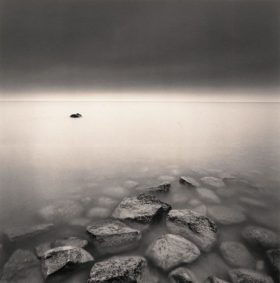
Foto di Michael Kenna


Càlati in un sasso,
io farei così.
Lascia che altri si facciano colomba
o digrignino i denti come tigri.
Mi basta essere un sasso.

All’esterno è un enigma:
nessuno sa come rispondere.
Ma fresco e quiete dev’esserci all’interno.
Anche se una mucca lo calca col suo peso,
anche se un bambino lo getta dentro un fiume;
il sasso affonda, lento, imperturbato,
fino al fondo,
dove i pesci bussano alla sua soglia
e vengono a origliare.

Ho visto scintille schizzar via
quando due sassi sono strofinati
forse là dentro non fa così buio;
forse c’è una luna che brilla
da chissà dove, spuntando magari dietro un colle —
un chiarore appena sufficiente a decifrare
quelle strane scritte, mappe stellari
sui muri interiori.

Charles Simic

(Traduzione di Andrea Molesini)

da “Hotel Insonnia”, Adelphi, 2002

∗∗∗

Stone

Go inside a stone
That would be my way.
Let somebody else become a dove
Or gnash with a tiger’s tooth.
I am happy to be a stone.

From the outside the stone is a riddle:
No one knows how to answer it.
Yet within, it must be cool and quiet
Even though a cow steps on it full weight,
Even though a child throws it in a river;
The stone sinks, slow, unperturbed
To the river bottom
Where the fishes come to knock on it
And listen.

I have seen sparks fly out
When two stones are rubbed,
So perhaps it is not dark inside after all;
Perhaps there is a moon shining
From somewhere, as though behind a hill —
Just enough light to make out
The strange writings, the star-charts
On the inner walls.

Charles Simic

da “Dismantling the Silence: Poems”, G. Braziller, 1971

e così vorresti fare lo scrittore? – Charles Bukowski

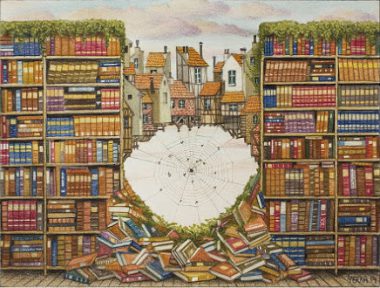
Dipinto di Jacek Yerka


se non ti esplode dentro
a dispetto di tutto,
non farlo.
a meno che non ti venga dritto dal
cuore e dalla mente e dalla bocca
e dalle viscere,
non farlo.
se devi startene seduto per ore
a fissare lo schermo del computer
o curvo sulla
macchina da scrivere
alla ricerca delle parole,
non farlo.
se lo fai per soldi o per
fama,
non farlo.
se lo fai perché vuoi
delle donne nel letto,
non farlo.
se devi startene lì a
scrivere e riscrivere,
non farlo.
se è già una fatica il solo pensiero di farlo,
non farlo.
se stai cercando di scrivere come qualcun
altro,
lascia perdere.

se devi aspettare che ti esca come un
ruggito,
allora aspetta pazientemente.
se non ti esce mai come un ruggito,
fai qualcos’altro.
se prima devi leggerlo a tua moglie
o alla tua ragazza o al tuo ragazzo
o ai tuoi genitori o comunque a qualcuno,
non sei pronto.

non essere come tanti scrittori,
non essere come tutte quelle migliaia di
persone che si definiscono scrittori,
non essere monotono e noioso e
pretenzioso, non farti consumare dall’auto-
compiacimento.
le biblioteche del mondo hanno
sbadigliato
fino ad addormentarsi
per tipi come te.
non aggiungerti a loro.
non farlo.
a meno che non ti esca
dall’anima come un razzo,
a meno che lo star fermo
non ti porti alla follia o
al suicidio o all’omicidio,
non farlo.
a meno che il sole dentro di te stia
bruciandoti le viscere,
non farlo.

quando sarà veramente il momento,
e se sei predestinato,
si farà da
sé e continuerà
finché tu morirai o morirà in
te.

non c’è altro modo.

e non c’è mai stato.

Charles Bukowski

(Traduzione di Simona Viciani)

da “E così vorresti fare lo scrittore?”, Guanda, 2007

***

so you want to be a writer?

if it doesn’t come bursting out of you
in spite of everything,
don’t do it.
unless it comes unasked out of your
heart and your mind and your mouth
and your gut,
don’t do it.
if you have to sit for hours
staring at your computer screen
or hunched over your
typewriter
searching for words,
don’t do it.
if you’re doing it for money or
fame,
don’t do it.
if you’re doing it because you want
women in your bed,
don’t do it.
if you have to sit there and
rewrite it again and again,
don’t do it.
if it’s hard work just thinking about doing it,
don’t do it.
if you’re trying to write like somebody
else,
forget about it.

if you have to wait for it to roar out of
you,
then wait patiently.
if it never does roar out of you,
do something else.
if you first have to read it to your wife
or your girlfriend or your boyfriend
or your parents or to anybody at all,
you’re not ready.

don’t be like so many writers,
don’t be like so many thousands of
people who call themselves writers,
don’t be dull and boring and
pretentious, don’t be consumed with self-
love.
the libraries of the world have
yawned themselves to
sleep
over your kind.
don’t add to that.
don’t do it.
unless it comes out of
your soul like a rocket,
unless being still would
drive you to madness or
suicide or murder,
don’t do it.
unless the sun inside you is
burning your gut,
don’t do it.

when it is truly time,
and if you have been chosen,
it will do it by
itself and it will keep on doing it
until you die or it dies in
you.

there is no other way.

and there never was.

Charles Bukowski

da “Sifting Through the Madness for the Word, the Line, the Way”,  Ecco Press, New York, 2003

William e Emily – Edgar Lee Masters

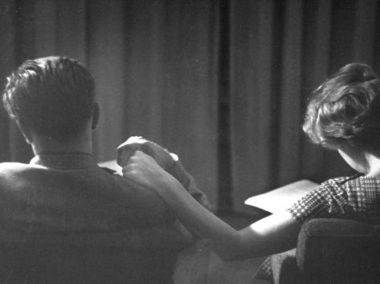
Nina Leen, Holding hands, 1940


C’è qualcosa nella Morte
che ricorda l’amore.
Se con qualcuno con cui avete conosciuto la passione,
e la vampa del giovane amore,
dopo anni di vita comune,
sentite spegnersi la fiamma;
e cosí insieme svanite,
a poco a poco, soavemente,
per cosí dire abbracciati,
nella stanza consueta –
c’è, fra gli spiriti, un unisono
che ricorda l’amore!

Edgar Lee Masters

(Traduzione di Fernanda Pivano)

da “Spoon River Anthology”, Einaudi Editore, 1943

∗∗∗

William and Emily

There is something about Death
Like love itself!
If with some one with whom you have known passion,
And the glow of youthful love,
You also, after years of life
Together, feel the sinking of the fire,
And thus fade away together,
Gradually, faintly, delicately,
As it were in each other’s arms,
Passing from the familiar room –
That is a power of unison between souls
Like love itself!

Edgar Lee Masters

da “Spoon River Anthology”, Mc Millan Company, New York, 1916