Per Tess – Raymond Carver

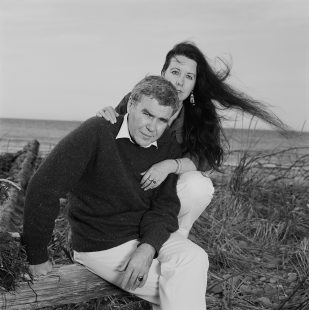
Bonnie Schiffman, Tess Gallagher and Raymond Carver


Giù nello Stretto le onde schiumano
come dicono qui. Il mare è mosso e meno male
che non sono uscito. Sono contento d’aver pescato
tutto il giorno a Morse Creek, trascinando avanti
e indietro un Daradevil rosso. Non ho preso niente.
Neanche un morso. Ma mi sta bene così. È stato bello!
Avevo con me il temperino di tuo padre e sono stato seguito
per un po’ da una cagnetta che i padroni chiamavano Dixie.
A volte mi sentivo così felice che dovevo smettere
di pescare. A un certo punto mi sono sdraiato sulla sponda
e ho chiuso gli occhi per ascoltare il rumore che faceva l’acqua
e il vento che fischiava sulla cima degli alberi. Lo stesso vento
che soffia giù nello Stretto, eppure è diverso.
Per un po’ mi son lasciato immaginare che ero morto
e mi stava bene anche quello, almeno per un paio
di minuti, finché non me ne sono ben reso conto: Morto.
Mentre me ne stavo lì sdraiato a occhi chiusi,
dopo essermi immaginato come sarebbe stato
se non avessi davvero potuto più rialzarmi, ho pensato a te.
Ho aperto gli occhi e mi sono alzato subito
e son ritornato a esser contento.
È che te ne sono grato, capisci. E te lo volevo dire.

Raymond Carver

(Traduzione di Riccardo Duranti)

da “Racconti in forma di poesia”, Ed. Minimum Fax, 1999

∗∗∗

For Tess

Out on the Strait the water is whitecapping,
as they say here. It’s rough, and I’m glad
I’m not out. Glad I fished all day
on Morse Creek, casting a red Daredevil back
and forth. I didn’t catch anything. No bites
even, not one. But it was okay. It was fine!
I carried your dad’s pocketknife and was followed
for a while by a dog its owner called Dixie.
At times I felt so happy I had to quit
fishing. Once I lay on the bank with my eyes closed,
listening to the sound the water made,
and to the wind in the tops of the trees. The same wind
that blows out on the Strait, but a different wind, too.
For a while I even let myself imagine I had died –
and that was all right, at least for a couple
of minutes, until it really sank in: Dead.
As I was lying there with my eyes closed,
just after I’d imagined what it might be like
if in fact I never got up again, I thought of you.
I opened my eyes then and got right up
and went back to being happy again.
I’m grateful to you, you see. I wanted to tell you.

Raymond Carver

da “All Of Us: The Collected Poems”, New York: Alfred A.Knopf, 1998

L’antica epoca della nostalgia – Mark Strand

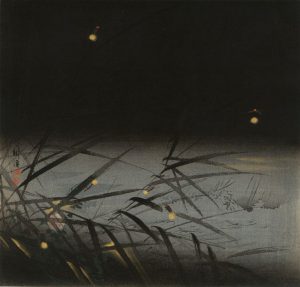
Kōgyo Tsukioka, Fireflies, 1910


Quelle ore concesse al crogiolarsi nel lucore di un futuro presunto, dell’essere trascinati via in torrenti di promessa da un amore o una passione così intensi che ci si sentiva cambiati per sempre e convinti che anche la più minuscola particella del mondo circostante fosse carica del proposito di un’impossibile grandeur; ah, sì, e si sarebbe guardato all’insù tra gli alberi e ci si sarebbe sentiti elettrizzati dal fiume sprigionato dal vento che faceva cascate del fogliame pallido, dorato, e dal cinguettio acuto e melodioso di innumerevoli uccelli; quei momenti, così numerosi e così remoti nel tempo, tornano ancora, ma brevi, come lucciole nell’afa fragrante di una sera d’estate.

Mark Strand

(Traduzione di Damiano Abeni)

da “Quasi invisibile”, “Lo Specchio” Mondadori, 2014

***

The Old Age of  Nostalgia

Those hours given over to basking in the glow of an imagined future, of being carried away in streams of promise by a love or a passion so strong that one felt altered forever and convinced that even the smallest particle of the surrounding world was charged with a purpose of impossible grandeur; ah, yes, and one would look up into the trees and be thrilled by the wind-loosened river of pale, gold foliage cascading down and by the high, melodious singing of countless birds; those moments, so many and so long ago, still come back, but briefly, like fireflies in the perfumed heat of a summer night.

Mark Strand 

da “Almost Invisible: Poems”, Alfred A. Knopf, 2012

Frammento di tempesta – Mark Strand

Pierre Houcmant, Anne-Véronique

Per Sharon Horvarth

Dall’ombra delle cupole nella città delle cupole,
un fiocco di neve, tormenta al singolare, impalpabile,
è entrato nella tua stanza e s’è fatto strada 
fino al bracciolo della poltrona dove tu, alzando lo sguardo
dal libro, lo scorgesti nell’attimo in cui si posava. Tutto 
qui. Null’altro che un solenne destarsi
alla brevità, al sollevarsi e al cadere dell’attenzione, rapido,
un tempo tra tempi, funerale senza fiori. Null’altro
tranne la sensazione che questo frammento di tempesta,
dissoltosi davanti ai tuoi occhi possa tornare,
che qualcuno negli anni a venire, seduta come adesso sei tu, possa dire:
«È ora. L’aria è pronta. C’è uno spiraglio nel cielo».

Mark Strand

(Traduzione di Damiano Abeni)

da “Tormenta al singolare”, in “L’inizio di una sedia”, Donzelli Poesia, 1999

∗∗∗

A Piece of Storm

                                                                                          for Sharon Horvath

From the shadow of domes in the city of domes,
A snowflake, a blizzard of one, weightless, entered your room
And made its way to the arm of the chair where you, looking up
From your book, saw it the moment it landed. That’s all
There was to it. No more than a solemn waking
To brevity, to the lifting and falling away of attention, swiftly,
A time between times, a flowerless funeral. No more than that
Except for the feeling that this piece of the storm,
Which turned into nothing before your eyes, would come back,
That someone years hence, sitting as you are now, might say:
«It’s time. The air is ready. The sky has an opening».

 Mark Strand

da “Blizzard of One”, New York: Alfred A. Knopf, 1988

«Come se il mare separandosi» – Emily Dickinson

Emil Nolde, Mare al crepuscolo, acquerello su carta, s.d.

695

Come se il mare separandosi
svelasse un altro mare,
questo un altro, ed i tre
solo il presagio fossero

d’un infinito di mari
non visitati da riva −
il mare stesso al mare fosse riva−
questo è l’eternità.

Emily Dickinson

c.1863

(Traduzione di Margherita Guidacci)

da “Tutte le poesie”, “I Meridiani” Mondadori, 1997

∗∗∗

695

As if the Sea should part
And show a further Sea −
And that – a further – and the Three
But a Presumption be –

Of Periods of Seas –
Unvisited of Shores –
Themselves the Verge of Seas to be –
Eternity – is Those –

Emily Dickinson

da “The Complete Poems of Emily Dickinson”, Thomas H. Johnson, ed., Boston, Mass.: Little, Brown, and Company, 1929

«Vederla è un quadro −» – Emily Dickinson

1568

Vederla è un quadro −
Ascoltarla è una musica 
Conoscerla un eccesso
Così innocente come giugno −
Non conoscerla − afflizione −
Averla come amica
È come se nella tua mano
Ardesse un calore simile al sole.

Emily Dickinson

c.1883

(Traduzione di Annalisa Cima e Eugenio Montale)

da “Tutte le poesie”, “I Meridiani” Mondadori, 1997

∗∗∗

1568

To see her is a Picture −
To hear her is a Tune −
To know her an Intemperance
As innocent as June −
To know her not − Affliction −
To own her for a Friend
A warmth as near as if the Sun
Were shining in your Hand.

Emily Dickinson

da “Bolts of Melody: New Poems of Emily Dickinson”, New York: Harper, 1945