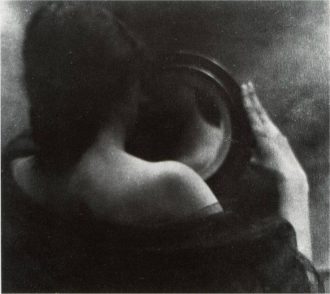
Specchio – Sylvia Plath

Edward Steichen, The Mirror, 1905


Sono d’argento e rigoroso. Non ho preconcetti.
Quello che vedo lo ingoio all’istante 
così com’è, non velato da amore o da avversione.
Non sono crudele, sono solo veritiero—
l’occhio di un piccolo dio, quadrangolare.
Passo molte ore a meditare sulla parete di fronte.
È rosa e macchiettata. La guardo da tanto tempo
che credo faccia parte del mio cuore. Ma c’è e non c’è.
Facce e buio ci separano ripetutamente.
Ora sono un lago. Una donna si china su di me,
cercando nella mia distesa ciò che essa è veramente.
Poi si volge alle candele o alla luna, quelle bugiarde.
Vedo la sua schiena e la rifletto fedelmente.
Lei mi ricompensa con lacrime e un agitare di mani.
Sono importante per lei. Va e viene.
Ogni mattina è sua la faccia che prende il posto del buio.
In me ha annegato una ragazza e in me una vecchia
sale verso di lei giorno dopo giorno come un pesce tremendo.

Sylvia Plath

23 ottobre 1961

(Traduzione di Anna Ravano)

da “Attraversando l’acqua”, in “I capolavori di Sylvia Plath”, Mondadori, 2004

∗∗∗

Mirror

I am silver and exact. I have no preconceptions.
Whatever I see I swallow immediately
Just as it is, unmisted by love or dislike.
I am not cruel, only truthful—
The eye of the little god, four cornered.
Most of the time I meditate on the opposite wall.
It is pink, with speckles. I have looked at it so long
I think it is a part of my heart. But it flickers.
Faces and darkness separate us over and over.
Now I am a lake. A woman bends over me,
Searching my reaches for what she really is.
Then she turns to those liars, the candles or the moon.
I see her back, and reflect it faithfully.
She rewards me with tears and an agitation of hands.
I am important to her. She comes and goes.
Each morning it is her face that replaces the darkness.
In me she has drowned a young girl, and in me an old woman
Rises toward her day after day, like a terrible fish.

Sylvia Plath

23 October 1961

da “Crossing the Water: Transitional Poems”. Edited by Ted Hughes. New York: Harper, 1971

Il destino si diverte – Ted Hughes


Poiché il messaggio si imbattè in un folletto,
poiché i precedenti fecero lo sgambetto alle attese,
poiché la tua Londra era ancora un caleidoscopio
di nomi e luoghi rimescolabili a ogni scossa,
aspettasti e ti sbagliavi. La corriera del Nord
arrivò, si svuotò, e io non c’ero.
Avesti un bell’insistere
e implorare l’autista, con probabili lacrime,
di farmi saltar fuori o ricordarsi d’avermi visto
mancare di un soffio la partenza. Non c’ero.
Le otto di sera: ero disperso
in qualche punto dell’Inghilterra. Tenesti a freno
la tua fiduciosa ispirazione
e non ti buttasti nel traffico che vorticava
intorno alla Victoria Station, con la certezza assoluta
di incrociarmi dove dovevo essere, per strada.
Io non ero per strada né lì né altrove. Ero seduto
placido al mio posto sul treno
che andava dondolando verso King’s Cross. Qualcuno,
più calmo di te, ebbe un suggerimento. E fu così che
quando scesi dal treno, pensando di trovarti
in qualche punto all’inizio del binario,
vidi quel maroso e quell’agitazione, una figura
che fendeva di petto la corrente dei passeggeri liberati,
poi il tuo viso liquefatto, gli occhi liquefatti
e le tue esclamazioni, le braccia agitate,
le lacrime sparse
come se fossi ritornato dai morti
contro ogni possibilità, contro
ogni negazione salvo la tua preghiera
ai tuoi dèi. Lì capii cosa significa
essere un miracolo. E dietro di te
il tuo allegro tassista, che rideva, come un piccolo dio,
nel vedere un’americana fare tanto l’americana,
nel vedere la tua folle corsa di bighe –
i tuoi singhiozzi, gli incitamenti, le suppliche
di far accadere ciò che avevi bisogno che accadesse –
così completamente vittoriosa, grazie a lui.
Be’, fu una combinazione straordinaria
che il mio treno non arrivasse prima, molto prima,
che entrasse in stazione, in ritardo, nel momento esatto
in cui tu irrompevi sul marciapiede. Fu
naturale e miracoloso, e fu un presagio
che confermava tutto quanto
volevi confermato. E la tua immensa disperazione,
la corsa nel panico per Londra
e ora il tuo trionfo mi piovvero addosso
come un amore ingrandito quarantanove volte,
come il primo fragoroso rovescio che sommerge
la siccità di agosto,
quando l’intera terra spaccata sembra sussultare
e ogni foglia trema
e ogni cosa leva le braccia piangendo.

Ted Hughes

(Traduzione di Anna Ravano)

da “Lettere di compleanno”, Mondadori, Milano, 1999

∗∗∗

Fate Playing

Because the message somehow met a goblin,
Because precedents tripped your expectations,
Because your London was still a kaleidoscope
Of names and places any jolt could scramble,
You waited mistaken. The bus from the North
Came in and emptied and I was not on it.
No matter how much you insisted
And begged the driver, probably with tears,
To produce me or to remember seeing me
Just miss getting on. I was not on it.
Eight in the evening and I was lost and at large
Somewhere in England. You restrained
Your confident inspiration
And did not dash out into the traffic
Milling around Victoria, utterly certain
Of bumping into me where I would have to be walking.
I was not walking anywhere. I was sitting
Unperturbed, in my seat on the train
Rocking towards King’s Cross. Somebody,
Calmer than you, had a suggestion. So,
When I got off the train, expecting to find you
Somewhere down at the root of the platform,
I saw that surge and agitation, a figure
Breasting the flow of released passengers,
Then your molten face, your molten eyes
And your exclamations, your flinging arms
Your scattering tears
As if I had come back from the dead
Against every possibility, against
Every negative but your own prayer
To your own gods. There I knew what it was
To be a miracle. And behind you
Your jolly taxi-driver, laughing, like a small god,
To see an American girl being so American,
And to see your frenzied chariot-ride –
Sobbing and goading him, and pleading with him
To make happen what you needed to happen –
Succeed so completely, thanks to him.
Well, it was a wonder
That my train was not earlier, even much earlier,
That it pulled in, late, the very moment
You irrupted onto the platform. It was
Natural and miraculous and an omen
Confirming everything
You wanted confirmed. So your huge despair,
Your cross-London panic dash
And now your triumph, splashed over me,
Like love forty-nine times magnified,
Like the first thunder cloudburst engulfing
The drought in August
When the whole cracked earth seems to quake
And every leaf trembles
And everything holds up its arms weeping.

Ted Hughes

da “Birthday Letters”, Faber & Faber Publication, 1998

Poesia d’amore – Charles Simic

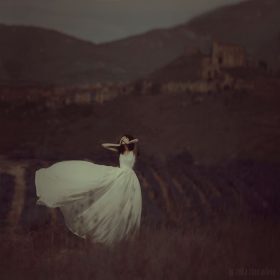
Foto di Anka Zhuravleva


Spolverino di piume.
Gabbia d’uccelli fatta di bisbigli.
Coda di un gatto nero.

Sono un bambino che corre
con le forbici aperte.
E con gli occhi bendati.

Tu sei un cuore che batte
nella selva oscura.
Sei l’urlo sulla ruota panoramica.

Proprio così, bruja
che batti il piede con le mani ai fianchi.

Notte sulla fiera.
Orchestra di legni.
Due borsaioli ciechi nella folla.

Charles Simic

(Traduzione di Andrea Molesini)

da “Hotel Insonnia”, Adelphi, 2002

∗∗∗

Love poem

Feather duster.
Birdcage made of whispers.
Tail of a black cat.

I’m a child running
With open scissors.
My eyes are bandaged.

You are a heart pounding
In a dark forest.
The shriek from the Ferris wheel.

That’s it, bruja
With arms akimbo
Stamping your foot.

Night at the fair.
Woodwind band.
Two blind pickpockets in the crowd.

Charles Simic

da “Jackstraws: Poems”, Houghton Mifflin Harcourt, 2000 

Febbre a 40° – Sylvia Plath


Pura? Che vuol dire?
Le lingue dell’inferno
sono ottuse, ottuse come le tre lingue

dell’ottuso e grasso Cerbero
che ansima all’ingresso. Incapaci
di pulire leccando

il tendine febbrile, il peccato, il peccato.
L’esca da fuoco stride.
L’indelebile odore

di una candela soffocata!
Amore, amore, i bassi fumi si svolgono
da me come le sciarpe di Isadora, ho il terrore

che una s’impigli e resti presa nella ruota.
Fumi così gialli e tetri
creano il proprio elemento. Invece di levarsi

rotolano intorno al globo
soffocando i vecchi e i mansueti,
il gracile

bimbo di serra nella culla,
l’orrida orchidea
che appende il suo giardino pensile nell’aria,

diabolico leopardo!
La radiazione l’ha resa bianca
e in un’ora l’ha uccisa.

Ungono i corpi degli adulteri
come cenere di Hiroshima e li corrodono.
Il peccato. Il peccato.

Tesoro, è tutta la notte
che vacillo, spenta, accesa, spenta, accesa.
Le lenzuola si fanno grevi come il bacio di un vizioso.

Tre giorni. Tre notti.
Acqua e limone, acqua
di pollo, acqua mi fanno vomitare.

Sono troppo pura per te o per chiunque.
Il tuo corpo
mi fa male come il mondo fa male a Dio. Sono una lanterna——

la mia testa una luna
di carta giapponese, la mia pelle oro in foglia
infinitamente delicata e infinitamente costosa.

Non ti sbalordisce il mio calore? E la mia luce.
Tutta sola, sono un’enorme camelia
che arde e viene e va, vampa su vampa.

Sto sollevandomi, credo.
Credo che salirò——
I grani di metallo bollente volano, e io, amore, io

sono una pura
vergine
di acetilene, scortata da rose,

da baci e cherubini,
da tutte queste strane cose rosa.
Non tu, né lui,

non lui, né lui
(i miei io che si dissolvono, vecchie gonnelle di puttana)——
verso il Paradiso.

Sylvia Plath

20 ottobre 1962

(Traduzione di Anna Ravano)

da “Ariel”, in “I capolavori di Sylvia Plath”, Mondadori, Milano, 2004

***

Fever 103°

Pure? What does it mean?
The tongues of hell
Are dull, dull as the triple

Tongues of dull, fat Cerberus
Who wheezes at the gate. Incapable
Of licking clean

The aguey tendon, the sin, the sin.
The tinder cries.
The indelible smell

Of a snuffed candle!
Love, love, the low smokes roll
From me like Isadora’s scarves, I’m in a fright

One scarf will catch and anchor in the wheel.
Such yellow sullen smokes
Make their own element. They will not rise,

But trundle round the globe
Choking the aged and the meek,
The weak

Hothouse baby in its crib,
The ghastly orchid
Hanging its hanging garden in the air,

Devilish leopard!
Radiation turned it white
And killed it in an hour.

Greasing the bodies of adulterers
Like Hiroshima ash and eating in.
The sin. The sin.

Darling, all night
I have been flickering, off, on, off, on.
The sheets grow heavy as a lecher’s kiss.

Three days. Three nights.
Lemon water, chicken
Water, water make me retch.

I am too pure for you or anyone.
Your body
Hurts me as the world hurts God. I am a lantern——

My head a moon
Of Japanese paper, my gold beaten skin
Infinitely delicate and infinitely expensive.

Does not my heat astound you. And my light.
All by myself I am a huge camellia
Glowing and coming and going, flush on flush.

I think I am going up,
I think I may rise——
The beads of hot metal fly, and I, love, I

Am a pure acetylene
Virgin
Attended by roses,

By kisses, by cherubim,
By whatever these pink things mean.
Not you, nor him

Not him, nor him
(My selves dissolving, old whore petticoats)——
To Paradise.

Sylvia Plath

20 October 1962

da “Ariel”, London, Faber and Faber, 1965

Poesia di Auburn – Hayden Carruth

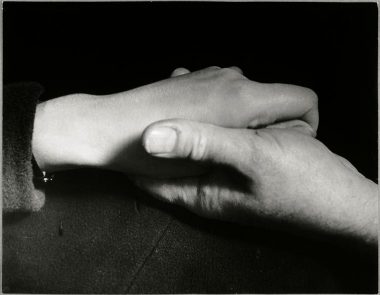
Brassaï, The Hands of Léon-Paul Fargue and Louise de Vilmorin, 1935


Un libro che leggevo stamattina
di Milan Kundera dice così: “Nell’algebra
dell’amore un figlio è il simbolo della magica

somma di due esseri”. E ora quella figlia
ha trentanove anni; soffre
di un cancro che ci hanno detto incurabile

e le sarà fatale. Sei stata sposata
per trent’anni a un altro uomo, ed io
ho sposato altre tre donne

e convissuto con sei –
una sciagura ma è così, compiuta
e irrevocabile. Siamo vecchi. Tu hai

sessantanove anni ed io settanta. Sarebbe
follia sentimentale dire di scorgere in te,
o tu in me, i lineamenti della nostra

giovinezza in amore. Eppure è vero. La tua voce
soprattutto mi riporta indietro. Siamo qui
perché nostra figlia, concepita a Chicago

in una bella notte d’aprile tanto tempo fa,
è tragicamente vulnerabile. Ci incontriamo angosciati,
in una disperazione muta. Ci incontriamo dopo anni

di separazione e di appena affettuosa
noncuranza. Ma è vero, vero, questa figlia
che è una donna matura, sofferente

con figli propri, è tuttora un simbolo
di quella magica somma che eravamo, e in questa
sventura, senza parole o tocco o sguardo

furtivo, io mi stringo a te, e so
di essere accettato senza parole o tocco o sguardo
furtivo. Questa, così tardi, la crisi delle nostre vite.

Hayden Carruth

(Traduzione di Fiorenza Mormile)

dalla rivista “Poesia”, Anno XXX, Febbraio 2017, N. 323, Crocetti Editore

∗∗∗

Auburn Poem

A book I was reading this morning
by Milan Kundera contains this: “In the algebra
of love a child is the symbol of the magical

sum of two beings.” And now that child
is thirty-nine years old; she is suffering
from a cancer which we are told is incurable

and will become fatal. You have been married
for thirty years to another man, and I
have been married to three other women

and have lived with six whom I did not
marry – a disgrace but there it is, done
and irrevocable. We are old. You are

sixty-nine and I am seventy. It would be
sentimental folly to say I can see in you,
or you in me, the lineaments of our

loving youth. Yet it is true. Your voice
especially takes me back. We are here
because our daughter, whom we conceived

one fine April night in Chicago long ago,
is crucially vulnerable. We meet in agony,
in wordless despair. We meet after years

of separation and mildly affectionate
unconcern. But it’s true, true, this child
who is a mature, afflicted woman

with children of her own, is still a symbol
of that magical sum we were, and in this
wretchedness, without word or touch or hidden

glance, I hold myself out to you, and I know
I am accepted without word or touch or hidden
glance. This, so late, the crisis of our lives.

Hayden Carruth

da “Scrambled Eggs & Whiskey: Poems, 1991-1995”, Copper Canyon Press, 1996