«Portami il tramonto in una tazza» – Emily Dickinson

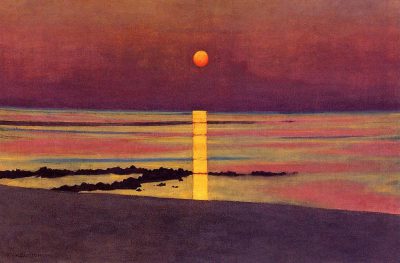
Félix Vallotton, Sunset, Bronze-Purple, 1911

128

Portami il tramonto in una tazza
conta le anfore del mattino
le gocce di rugiada.
Dimmi fin dove arriva il mattino –
quando dorme colui che tesse
d’azzurro gli spazi.

Scrivimi quante sono le note
nell’estasi del nuovo pettirosso
tra i rami stupefatti – quanti passetti
fa la tartaruga –
Quante coppe di rugiada beve
l’ape viziosa.

E chi gettò i ponti dell’arcobaleno,
chi conduce le docili sfere
con intrecci di tenero azzurro.
Quali dita congiungono le stalattiti,
chi conta le conchiglie della notte
attento che non ne manchi una.

Chi costruì questa casetta bianca
e chiuse così bene le finestre
che non riesco a vedere fuori.
Chi mi farà uscire con quanto mi occorre
in un giorno di festa –
per volare via – in pompa magna.

Emily Dickinson

(Traduzione di Gabriella Sobrino)

c. 1859

da “Emily Dickinson, Poesie”, Newton Compton, Roma, 1987

∗∗∗

 128

Bring me the sunset in a cup
Reckon the morning’s flagon’s up
And say how many Dew,
Tell me how far the morning leaps –
Tell me what time the weawer sleeps
Who spun the breadths of blue!

Write me how many notes there be
In the new Robin’s extasy
Among astonished boughs –
How many trips the Tortoise makes –
How many cups the Bee partakes,
the Debauchee of Dews!

Also, who laid the Rainbow’s piers,
Also, who leads the docile spheres
By withes of supple blue?
Whose fingers string the stalactite –
Who count the wampum of the night
To see that none is due?

Who built this little Alban House
and shut the window down so close
My spirit cannot see?
Who’ll let me out some gala day
With implements to fly away
Passing Pomposity?

Emily Dickinson

c. 1859

da “Poems”, a cura di Mabel Loomis Todd e Thomas W. Higginson, Boston, Robert Brothers, 1891

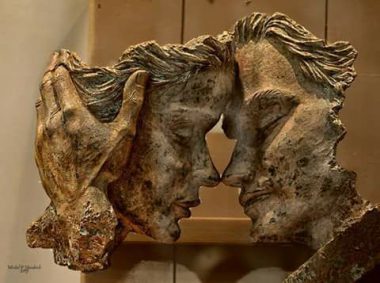
io porto il tuo cuore in me… – Edward Estlin Cummings

Michel Hendrich, 2015

96.

io porto il tuo cuore in me (lo porto nel
mio cuore) non lo lascio mai (ovunque
vado tu vai, cara; e quel che faccio
io da solo lo fai tu, tesoro mio)
                                                         non temo
fato (tu sei il mio fato, mia dolce) né
voglio il mondo (bella, mio mondo, mia fedele)
tu sei quel che luna sempre fu
e quel che un sole sempre canterà sei tu

qui sta il piú grande segreto che nessuno sa
(qui l’intima radice e bocciolo e cielo
di un albero chiamato vita; che cresce
piú alto di quanto anima speri e mente
celi) e questa meraviglia regge le stelle
io porto il tuo cuore (lo porto nel mio cuore)

Edward Estlin Cummings

(Traduzione di Mary de Rachewiltz)

da “Edward Estlin Cummings, Poesie”, Einaudi, Torino, 1974

***

96.

i carry your heart with me (i carry it in
my heart) i am never without it (anywhere
i go you go, my dear; and whatever is done
by only me is your doing, my darling)
                                                                        i fear
no fate (for you are my fate, my sweet)i want
no world (for beautiful you are my world, my true)
and it’s you are whatever a moon has always meant
and whatever a sun will always sing is you

here is the deepest secret nobody knows
(here is the root of the root and the bud of the bud
and the sky of the sky of a tree called life; which grows
higher than the soul can hope or mind can hide)
and this is the wonder that’s keeping the stars apart

i carry your heart (i carry it in my heart)

Edward Estlin Cummings

da “95 Poems”, Harcourt Brace, New York, 1958

Povero nord – Mark Strand

Foto di Paul Himmel


Fa freddo, la neve è alta,
il vento sbatte nella sua gabbia di piante,
le nuvole paiono stracci sozzi e laceri per l’uso,
e gli storni becchettano il ghiaccio.
È il nord, povero nord. Niente va bene.

Il capofamiglia è andato al lavoro,
vende sedie e sofà in un negozio che sta per fallire.
La moglie sta a casa e fissa dalla finestra le piante,
cerca di ricordare la vita che ha perso, anche se non era un granché.
Fiori bianchi di brina sbocciano sul vetro.

È quasi sera. Anatre e oche canadesi dormono
sulle acque della baia di Saint Margaret.
Marito e moglie passeggiano: guardate come si piegano
controvento; alzano il bavero
e i minuscoli sbuffi del loro respiro volano via.

Mark Strand

(Traduzione di Damiano Abeni)

da “Il futuro non è più quello di una volta”, minimum fax, Roma, 2006

∗∗∗

Poor North

It is cold, the snow is deep,
the wind beats around in its cage of trees,
clouds have the look of rags torn and soiled with use,
and starlings peck at the ice.
It is north, poor north. Nothing goes right.

The man of the house has gone to work,
selling chairs and sofas in a failing store.
His wife stays home and stares from the window into the trees,
trying to recall the life she lost, though it wasn’t much.
White flowers of frost build up on the glass.

It is late in the day. Brants and Canada geese are asleep
on the waters of St. Margaret’s Bay.
The man and his wife are out for a walk; see how they lean
into the wind; they turn up their collars
and the small puffs of their breath are carried away.

Mark Strand

da The Late Hour”, Atheneum, 1978

La vita tranquilla – Mark Strand

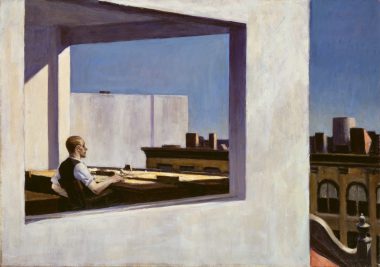
Edward Hopper, Office in a Small City, 1953


Sei in piedi alla finestra.
C’è una nube di vetro a forma di cuore.
I sospiri del vento sono caverne in ciò che dici.
Sei il fantasma sull’albero lì fuori.

La strada è muta.
Il clima, come il domani, come la tua vita,
è in parte qui, in parte per aria.
Non puoi farci niente.

La vita tranquilla non dà preavvisi.
Consuma i climi dello sconforto
e compare, a piedi, non riconosciuta, senza offrire nulla,
e tu sei lì.

Mark Strand

(Traduzione di Damiano Abeni)

da “Più buio”, 1970, in “L’uomo che cammina un passo avanti al buio”, Mondadori, Milano, 2011

∗∗∗

The good life

You stand at the window.
There is a glass cloud in the shape of a heart.
There are the wind’s sighs that are like caves in your speech.

You are the ghost in the tree outside.
The street is quiet.
The weather, like tomorrow, like your life,
is partially here, partially up in the air.

There is nothing you can do.
The good life gives no warning.
It weathers the climates of despair
and appears, on foot, unrecognized, offering nothing,
and you are there.

Mark Strand

da “Darker: poems”, Atheneum, 1970

«Tre volte al mio respiro dissi addio» – Emily Dickinson

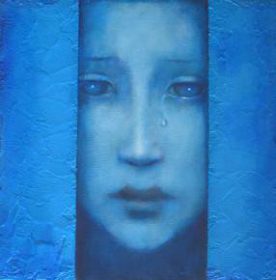
Nicoletta Thomas, Le finestre dell’anima

598

Tre volte al mio respiro dissi addio
e per tre volte non mi volle lasciare,
ma cercò di agitare il debole ventaglio
che l’acqua si sforzava di fermare.

Per tre volte le onde mi sospinsero in alto,
mi ripresero, poi, come una palla,
fecero smorfie azzurre sulla mia
faccia, e lontano spinsero una vela

che strisciava, distante qualche lega,
ed amavo vederla, pensando, nella morte,
com’era bello osservare quel punto
dov’eran volti umani.

Si fece sonnolenta l’onda, non il respiro.
Si cullavano i venti come bimbi,
e poi il sole baciò la mia crisalide
ed io mi alzai per vivere.

Emily Dickinson

c.1862

(Traduzione di Margherita Guidacci)

da “Tutte le poesie”, “I Meridiani” Mondadori, 1997

∗∗∗

598

Three times – we parted – Breath – and I–
Three times – He would not go –
But strove to stir the lifeless fan
The Waters – strove to stay.

Three Times – the Billows tossed me up –
Then caught me – like a Ball –
Then made Blue faces in my face –
And pushed away a sail

That crawled Leagues off – I liked to see –
For thinking – while I die –
How pleasant to behold a Thing
Where Human faces – be –

The Waves grew sleepy – Breath – did not –
The Winds – like Children – lulled –
Then Sunrise kissed my Chrysalis –
And I stood up – and lived –

Emily Dickinson

da “The Complete Poems of Emily Dickinson”, Thomas H. Johnson, ed., Boston, Mass.: Little, Brown and Company, 1929