«Se in autunno tu venissi da me» – Emily Dickinson

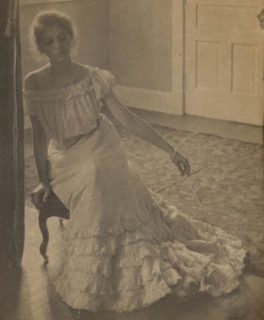
Clarence H. White, The Peacock Feather (Julia Hall McCune), 1902

511

Se in autunno tu venissi da me
caccerei l’estate
un po’ sorridente – un po’ irritata –
come la massaia scaccia una mosca.

Se potessi rivederti tra un anno
farei tanti gomitoli dei mesi –
li metterei in cassetti separati
per paura che i numeri si confondano.

Se l’attesa fosse soltanto di secoli
li conterei sulla mano
sottraendo finché non mi cadessero
le dita nel paese di Van Dieman.

E se fossi certa che finita questa vita
la mia e la tua continueranno a vivere
getterei la mia come una buccia
e sceglierei con te l’eternità.

Ma ora – incerta sulla durata del tempo –
che ci separa, la cosa m’inquieta,
come l’ape folletto,
che non avverte quando pungerà.

Emily Dickinson

(Traduzione di Gabriella Sobrino)

c.1863

da “Emily Dickinson, Poesie”, Newton Compton, Roma, 1987

∗∗∗

511

If you were coming in the Fall,
I’d brush the Summer by
With half a smile, and half a spurn,
As Housewives do, a Fly.

If I could see you in a year,
I’d wind the months in balls –
And put them each in separate Drawers,
For fear the numbers fuse –

If only Centuries, delayed,
I’d count them on my Hand,
Subtracting, till my fingers dropped
Into Van Dieman’s Land.

If certain, when this life was out –
That your’s and mine, should be –
I’d toss it yonder, like a Rind,
And take Eternity –

But, now, uncertain of the length
Of this, that is between,
It goads me, like the Goblin Bee –
That will not state – it’s sting.

Emily Dickinson

da “Poems”, a cura di Mabel Loomis Todd e Thomas W. Higginson, Boston, Robert Brothers, 1890

«Portami il tramonto in una tazza» – Emily Dickinson

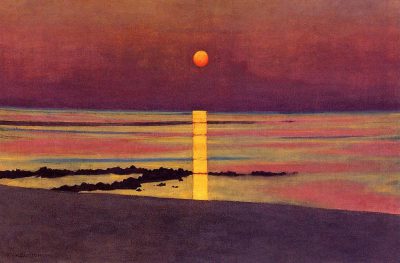
Félix Vallotton, Sunset, Bronze-Purple, 1911

128

Portami il tramonto in una tazza
conta le anfore del mattino
le gocce di rugiada.
Dimmi fin dove arriva il mattino –
quando dorme colui che tesse
d’azzurro gli spazi.

Scrivimi quante sono le note
nell’estasi del nuovo pettirosso
tra i rami stupefatti – quanti passetti
fa la tartaruga –
Quante coppe di rugiada beve
l’ape viziosa.

E chi gettò i ponti dell’arcobaleno,
chi conduce le docili sfere
con intrecci di tenero azzurro.
Quali dita congiungono le stalattiti,
chi conta le conchiglie della notte
attento che non ne manchi una.

Chi costruì questa casetta bianca
e chiuse così bene le finestre
che non riesco a vedere fuori.
Chi mi farà uscire con quanto mi occorre
in un giorno di festa –
per volare via – in pompa magna.

Emily Dickinson

(Traduzione di Gabriella Sobrino)

c. 1859

da “Emily Dickinson, Poesie”, Newton Compton, Roma, 1987

∗∗∗

 128

Bring me the sunset in a cup
Reckon the morning’s flagon’s up
And say how many Dew,
Tell me how far the morning leaps –
Tell me what time the weawer sleeps
Who spun the breadths of blue!

Write me how many notes there be
In the new Robin’s extasy
Among astonished boughs –
How many trips the Tortoise makes –
How many cups the Bee partakes,
the Debauchee of Dews!

Also, who laid the Rainbow’s piers,
Also, who leads the docile spheres
By withes of supple blue?
Whose fingers string the stalactite –
Who count the wampum of the night
To see that none is due?

Who built this little Alban House
and shut the window down so close
My spirit cannot see?
Who’ll let me out some gala day
With implements to fly away
Passing Pomposity?

Emily Dickinson

c. 1859

da “Poems”, a cura di Mabel Loomis Todd e Thomas W. Higginson, Boston, Robert Brothers, 1891

«Tre volte al mio respiro dissi addio» – Emily Dickinson

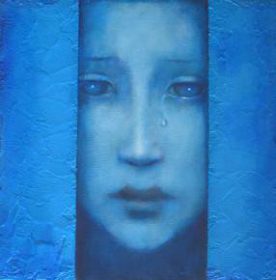
Nicoletta Thomas, Le finestre dell’anima

598

Tre volte al mio respiro dissi addio
e per tre volte non mi volle lasciare,
ma cercò di agitare il debole ventaglio
che l’acqua si sforzava di fermare.

Per tre volte le onde mi sospinsero in alto,
mi ripresero, poi, come una palla,
fecero smorfie azzurre sulla mia
faccia, e lontano spinsero una vela

che strisciava, distante qualche lega,
ed amavo vederla, pensando, nella morte,
com’era bello osservare quel punto
dov’eran volti umani.

Si fece sonnolenta l’onda, non il respiro.
Si cullavano i venti come bimbi,
e poi il sole baciò la mia crisalide
ed io mi alzai per vivere.

Emily Dickinson

c.1862

(Traduzione di Margherita Guidacci)

da “Tutte le poesie”, “I Meridiani” Mondadori, 1997

∗∗∗

598

Three times – we parted – Breath – and I–
Three times – He would not go –
But strove to stir the lifeless fan
The Waters – strove to stay.

Three Times – the Billows tossed me up –
Then caught me – like a Ball –
Then made Blue faces in my face –
And pushed away a sail

That crawled Leagues off – I liked to see –
For thinking – while I die –
How pleasant to behold a Thing
Where Human faces – be –

The Waves grew sleepy – Breath – did not –
The Winds – like Children – lulled –
Then Sunrise kissed my Chrysalis –
And I stood up – and lived –

Emily Dickinson

da “The Complete Poems of Emily Dickinson”, Thomas H. Johnson, ed., Boston, Mass.: Little, Brown and Company, 1929

«Ha una sua solitudine lo spazio» – Emily Dickinson

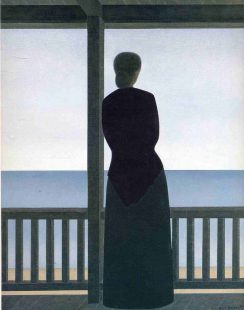
Will Barnet, Woman by the Sea

1695

Ha una sua solitudine lo spazio,
solitudine il mare
e solitudine la morte – eppure
tutte queste son folla
in confronto a quel punto più profondo,
segretezza polare,
che è un’anima a cospetto di se stessa –
infinità finita.

Emily Dickinson

(Traduzione di Margherita Guidacci)

da “Tutte le poesie”, “I Meridiani” Mondadori, 1997

∗∗∗

1695

There is a solitude of space
A solitude of sea
A solitude of death, but these
Society shall be
Compared with that profounder site
That polar privacy
A soul admitted to itself –
Finite infinity.

Emily Dickinson

da “The Single Hound: Poems of a Lifetime”, a cura di Martha Dickinson Bianchi, Boston, Little, Brown & Co, 1914

«Mi sono data a lui – e» – Emily Dickinson

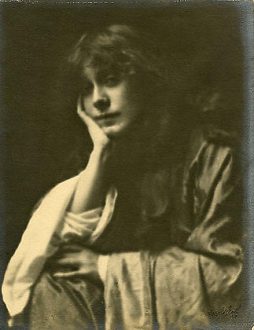
Arnold Genthe, Julia Marlowe, c.1911

580

Mi sono data a lui – e
lui mi sono presa per compenso.
Ho così chiuso
il solenne contratto d’una vita.

Ma l’acquisto potrebbe deludere
ed io alla prova potrei risultare
meno preziosa
di quanto supponga il grande compratore.

L’amore di ogni giorno
svaluta la visione;
ma finché il mercante è sull’acquisto
stanno ancora in un’isola d’aromi
i carichi squisiti della favola.

Almeno, il rischio è reciproco,
qualcuno vi scoprì pure un guadagno –
dolce peso del vivere – trovarsi
debitore ogni notte
ed insolvente ad ogni mezzodì.

Emily Dickinson

(Traduzione di Gabriella Sobrino)

c. 1862

da “Emily Dickinson, Poesie”, Newton Compton, Roma, 1987

∗∗∗

580

I gave myself to Him –
And took Himself, for Pay,
The solemn contract of a Life
Was ratified, this way –

The Wealth might disappoint –
Myself a poorer prove
Than this great Purchaser suspect,
The Daily Own – of Love

Depreciate the Vision –
But till the Merchant buy –
Still Fable – in the Isles of Spice –
The subtle Cargoes – lie –

At least – ’tis Mutual – Risk –
Some – found it – Mutual Gain –
Sweet Debt of Life – Each Night to owe –
Insolvent – every Noon –

Emily Dickinson

da “Poems”, a cura di Mabel Loomis Todd e Thomas W. Higginson, Boston, Robert Brothers, 1891