Una lettera – Anthony Hecht


                    Da un po’ mi sto chiedendo
a cosa pensi, e a questo punto mi sa
                    non a me, certamente.
Ma s’è destato il croco, e l’allodola, e il tremebondo
                    sangue sa quello che sa.
Parla da solo tutta notte, come un mare di luna semovente.

                   Certo, è di te che parla.
All’alba, su cui l’oceano ha issato il suo strascico di lumi,
                   il sole pianta un piede flessuoso
su quello scroscio di specchi, ma il sangue tarla
                   le tiepide notti d’Arabia,
pronunciando il tuo nome pulsante nelle buie radici del cuore.

                   Nome che, certo, resterà innominato.
Comunque, voglio tu sappia che ho fatto del mio meglio,
                   come son sicuro hai fatto anche tu.
Qualcun altro è legato a noi, incolpevole e garbato,
                   il cui nome sta nel garbuglio
delle ciance incessanti. Carissima, il limpido, insepolto blu

                   di quegli abissi è quasi accecante.
Forse ricordi la volta che portasti ai miei fanciulli
                   due uccelletti lanuti.
Ieri il primo mi ha chiesto di te – aveva ritrovato
                   il tuo piccolo tordo tra i suoi trastulli.
E le maree sono montate attorno a me, e sono rimasto muto.

                   C’è poco altro da raccontare.
Si dà il proprio meglio per continuare come in passato,
                   facendo qualche buona azione.
Ma vorrei che tu sapessi che non va tutto bene
                  quando un uomo è ferreo nella negazione
delle interminabili ripetizioni del proprio sangue sussurrato.

Anthony Hecht

(Traduzione di Damiano Abeni e Moira Egan)

da “Le ore dure”, Donzelli Poesia, 2018

∗∗∗

A Letter

                    I have been wondering
What you are thinking about, and by now suppose
                    It is certainly not me.
But the crocus is up, and the lark, and the blundering
                    Blood knows what it knows.
It talks to itself all night, like a sliding moonlit sea.

                   Of course, it is talking of you.
At dawn, where the ocean has netted its catch of lights,
                   The sun plants one lithe foot
On that spill of mirrors, but the blood goes worming through
                   Its warm Arabian nights,
Naming your pounding name again in the dark heart-root,

                   Who shall, of course, be nameless.
Anyway, I should want you to know I have done my best,
                   As I’m sure you have, too.
Others are bound to us, the gentle and blameless
                   Whose names are not confessed
In the ceaseless palaver. My dearest, the clear unquarried blue

                   Of those depths is all but blinding.
You may remember that once you brought my boys
                   Two little woolly birds.
Yesterday the older one asked for you upon finding
                   Your thrush among his toys.
And the tides welled about me, and I could find no words.

                   There is not much else to tell.
One tries one’s best to continue as before,
                   Doing some little good.
But I would have you know that all is not well
                   With a man dead set to ignore
The endless repetitions of his own murmurous blood.

Anthony Hecht

da “The hard hours: poems”, Atheneum, 1967

«È la “speranza” una creatura alata» – Emily Dickinson

Foto di Susan De Witt

254

È la “speranza” una creatura alata
che si annida nell’anima –
e canta melodie senza parole –
senza smettere mai –

E la senti dolcissima nel vento –
e ben aspra dev’esser la tempesta
che valga a spaventare il tenue uccello
che tanti riscaldò –

Nella landa più gelida l’ho udita –
sui più remoti mari –
ma nemmeno all’estremo del bisogno
ha voluto una briciola – da me.

Emily Dickinson

c. 1861

(Traduzione di Silvio Raffo)

da “Emily Dickinson, Tutte le poesie”, “I Meridiani” Mondadori, 1997

∗∗∗

254

“Hope” is the thing with feathers –
That perches in the soul –
And sings the tune without the words –
And never stops – at all –

And sweetest – in the Gale – is heard –
And sore must be the storm –
That could abash the little Bird
That kept so many warm –

I’ve heard it in the chillest land –
And on the strangest Sea –
Yet, never, in Extremity,
It asked a crumb – of Me.

Emily Dickinson

c. 1861

da “Poems”, a cura di Mabel Loomis Todd e Thomas W. Higginson, Boston, Robert Brothers, 1891

«Mi fu data dagli dei –» – Emily Dickinson

Allan Grant, A girl daydreaming during class, Florida, March 1947

[454]

Mi fu data dagli dei –
che ero bambina –
Ci fanno regali – si sa – perlopiú
quando siamo nuovi – e piccoli.
Io la tenevo in mano –
non l’ho mai posata –
non osavo mangiare – né dormire –
per paura che andasse via –
Udivo parole come «ricca» –
mentre correvo a scuola –
da labbra agli angoli delle strade –
e cercavo di resistere a un sorriso.
Ricca! Ero io proprio – a essere ricca –
a prendere il nome dell’oro –
e oro possedere – in barre massicce –
La differenza – mi rendeva fiera –

Emily Dickinson

(Traduzione di Silvia Bre)

da “Uno zero più ampio”, Einaudi, Torino, 2013

∗∗∗

[454]

It was given to me by the Gods –
When I was a little Girl –
They given us Presents most – you know –
When we are new – and small.
I kept it in my Hand –
I never put it down –
I did not dare to eat – or sleep –
For fear it would be gone –
I heard such words as «Rich» –
When hurrying to school –
From lips at Corners of the Streets –
And wrestled with a smile.
Rich! ’Twas Myself – was rich –
To take the name of Gold –
And Gold to own – in solid Bars –
The Difference – made me bold –

Emily Dickinson

da “The Poems of Emily Dickinson”, The Belknap Press of Harvard University Press, Cambridge (Mass.), 1955

Ernest Hyde – Edgar Lee Masters

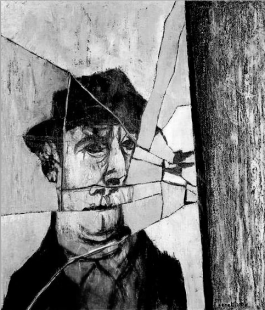
Mino Ceretti, Uomo allo specchio rotto, 1956


La mia mente era uno specchio:
vedeva ciò che vedeva, sapeva ciò che sapeva.
In gioventú la mia mente fu proprio uno specchio
in un vagone che fuggiva veloce
afferrando e perdendo squarci di paesaggio.
Poi col tempo
grandi graffi s’incisero sopra lo specchio
lasciando che il mondo esterno vi entrasse
e lasciando che vi affiorasse il mio io piú segreto.
Perché questa è la nascita dell’anima nel dolore,
una nascita con guadagni e perdite.
La mente vede il mondo come una cosa staccata,
e l’anima rende il mondo una cosa sola con se stessa.
Uno specchio graffiato non riflette immagini:
e questo è il silenzio della saggezza.

Edgar Lee Masters

(Traduzione di Fernanda Pivano)

da “Spoon River Anthology”, Einaudi Editore, 1943

∗∗∗

Ernest Hyde

My mind was a mirror:
It saw what it saw, it knew what it knew.
In youth my mind was just a mirror
In a rapidly flying car,
Which catches and loses bits of the landscape.
Then in time
Great scratches were made on the mirror,
Letting the outside world come in,
And letting my inner self look out.
For this is the birth of the soul in sorrow,
A birth with gains and losses.
The mind sees the world as a thing apart,
And the soul makes the world at one with itself.
A mirror scratched reflects no image –
And this is the silence of wisdom.

Edgar Lee Masters

da “Spoon River Anthology”, Mc Millan Company, New York, 1916

Il passato – Louise Glück

Louise Glück


All’improvviso appare una piccola luce
nel cielo tra
due rami di pino, i loro sottili aghi

ora incisi sulla superficie radiosa
e al di sopra di questo
alto, paradiso piumato –

Annusa l’aria. Questo è l’odore del pino bianco,
più intenso quando il vento lo attraversa
e rende il suono altrettanto strano,
come il suono del vento in un film –

Ombre in movimento. Le corde
facendo il suono che fanno. Quello che senti adesso
sarà il suono dell’usignolo, cordato ¹,
uccello maschio che corteggia la femmina –

Le corde oscillano. L’amaca
ondeggia al vento, legata
saldamente tra due alberi di pino.

Annusa l’aria. Questo è l’odore del pino bianco.

È la voce di mia madre che senti
o è solo il suono che fanno gli alberi
quando l’aria li attraversa

perché quale suono farebbe,
passando attraverso il nulla?

Louise Glück

(TRADUZIONE DI MARCELLO COMITINI)
¹riferimento a Chordata Bateson, genetista britannico
ALTRE POESIE DI LOUISE GLÜCK TRADOTTE DA MARCELLO COMITINI

∗∗∗

The past

Small light in the sky appearing
suddenly between
two pine boughs, their fine needles

now etched onto the radiant surface
and above this
high, feathery heaven—

Smell the air. That is the smell of the white pine,
most intense when the wind blows through it
and the sound it makes equally strange,
like the sound of the wind in a movie—

Shadows moving. The ropes
making the sound they make. What you hear now
will be the sound of the nightingale, chordata,
the male bird courting the female—

The ropes shift. The hammock
sways in the wind, tied
firmly between two pine trees.

Smell the air. That is the smell of the white pine.

It is my mother’s voice you hear
or is it only the sound the trees make
when the air passes through them

because what sound would it make,
passing through nothing?

Louise Glück

da “Faithful and Virtuous Night”, Farrar, Straus and Giroux, 2014