«Per te io curo questi fiori» – Emily Dickinson

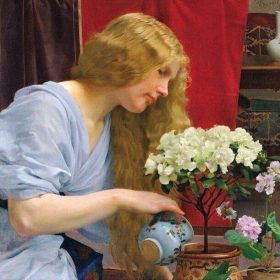
Vojtěch Hynais, Anka, 1913

339

Per te io curo questi fiori,
fulgido assente!
Si fendono le vene di corallo
della mia fucsia – ed io semino e sogno –

I gerani si tingono di chiazze –
umili margherite si frastagliano –
dirada il cactus le spinose punte
per mostrare la gola –

Stilla aromi il garofano
presto colti dall’ape –
un giacinto nascosto
sporge il capo arruffato –
esalano profumi
da fiale così tenui
che ti domandi come li serbassero –

Fiocchi di raso spargono le rose
sferiche sulla ghiaia del giardino –
pure – tu non sei qui –
e vorrei che i miei fiori
non avessero più rossi colori–

Che sia felice il fiore
e il suo signore – assente –
mi dà solo dolore –
in un calice grigio mi rinchiudo –
umilmente – per esser d’ora in poi
la tua margherita –
in lutto di te!

Emily Dickinson

c. 1862

(Traduzione di Silvio Raffo)

da “Tutte le poesie”, “I Meridiani” Mondadori, 1997

∗∗∗

339

I tend my flowers for thee –
Bright Absentee!
My Fuchsia’s Coral Seams
Rip – while the Sower – dreams –

Geraniums – tint – and spot–
Low Daisies – dot –
My Cactus – splits her Beard
To show her throat –

Carnations– tip their spice –
And Bees –pick up –
A Hyacinth – I hid –
Puts out a Ruffled Head –
And odors fall
From flasks – so small –
You marvel how they held –

Globe Roses –break their satin glake – 
Upon my Garden floor –
Yet – thou – not there –
I had as lief they bore
No Crimson – more –

Thy flower – be gay –
Her Lord – away!
It ill becometh me –
I’ll dwell in Calyx – Gray –
How modestly – alway –
Thy Daisy –
Draped for thee!

Emily Dickinson

da “The Complete Poems of Emily Dickinson”, Thomas H. Johnson, ed., Boston, Mass.: Little, Brown, and Company, 1929

«È la “speranza” una creatura alata» – Emily Dickinson

Foto di Susan De Witt

254

È la “speranza” una creatura alata
che si annida nell’anima –
e canta melodie senza parole –
senza smettere mai –

E la senti dolcissima nel vento –
e ben aspra dev’esser la tempesta
che valga a spaventare il tenue uccello
che tanti riscaldò –

Nella landa più gelida l’ho udita –
sui più remoti mari –
ma nemmeno all’estremo del bisogno
ha voluto una briciola – da me.

Emily Dickinson

c. 1861

(Traduzione di Silvio Raffo)

da “Emily Dickinson, Tutte le poesie”, “I Meridiani” Mondadori, 1997

∗∗∗

254

“Hope” is the thing with feathers –
That perches in the soul –
And sings the tune without the words –
And never stops – at all –

And sweetest – in the Gale – is heard –
And sore must be the storm –
That could abash the little Bird
That kept so many warm –

I’ve heard it in the chillest land –
And on the strangest Sea –
Yet, never, in Extremity,
It asked a crumb – of Me.

Emily Dickinson

c. 1861

da “Poems”, a cura di Mabel Loomis Todd e Thomas W. Higginson, Boston, Robert Brothers, 1891

«Mi fu data dagli dei –» – Emily Dickinson

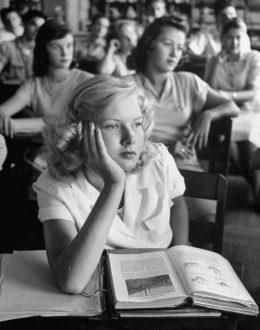
Allan Grant, A girl daydreaming during class, Florida, March 1947

[454]

Mi fu data dagli dei –
che ero bambina –
Ci fanno regali – si sa – perlopiú
quando siamo nuovi – e piccoli.
Io la tenevo in mano –
non l’ho mai posata –
non osavo mangiare – né dormire –
per paura che andasse via –
Udivo parole come «ricca» –
mentre correvo a scuola –
da labbra agli angoli delle strade –
e cercavo di resistere a un sorriso.
Ricca! Ero io proprio – a essere ricca –
a prendere il nome dell’oro –
e oro possedere – in barre massicce –
La differenza – mi rendeva fiera –

Emily Dickinson

(Traduzione di Silvia Bre)

da “Uno zero più ampio”, Einaudi, Torino, 2013

∗∗∗

[454]

It was given to me by the Gods –
When I was a little Girl –
They given us Presents most – you know –
When we are new – and small.
I kept it in my Hand –
I never put it down –
I did not dare to eat – or sleep –
For fear it would be gone –
I heard such words as «Rich» –
When hurrying to school –
From lips at Corners of the Streets –
And wrestled with a smile.
Rich! ’Twas Myself – was rich –
To take the name of Gold –
And Gold to own – in solid Bars –
The Difference – made me bold –

Emily Dickinson

da “The Poems of Emily Dickinson”, The Belknap Press of Harvard University Press, Cambridge (Mass.), 1955

«Ancora non l’ho detto al mio giardino –» – Emily Dickinson

Foto di Katia Chausheva

[50]

Ancora non l’ho detto al mio giardino –
perché mi potrebbe sopraffare.
Non ho certo la forza a questo punto
di rivelarlo all’ape –

Non ne farò parola per la strada
stupirebbe le botteghe che io –
quella cosí ignorante – cosí timida
abbia la sfrontatezza di morire.

Non devono saperlo le colline –
dove ho vagato tanto –
e non ditelo alle foreste devote
il giorno in cui dovrò andare –

né si sussurri a tavola –
né si accenni sbadatamente
per la via che oggi una entrerà
dentro l’enigma –

Emily Dickinson

(Traduzione di Silvia Bre)

da “Questa parola fidata”, Einaudi, Torino, 2019

∗∗∗

[50]

«I hav’nt told my garden yet –»

I hav’nt told my garden yet –
Lest that should conquer me.
I hav’nt quite the strength now
To break it to the Bee –

I will not name it in the street
For shops w’d stare at me –
That one so shy – so ignorant
Should have the face to die.

The hillsides must not know it –
Where I have rambled so –
Nor tell the loving forests
The day that I shall go –

Nor lisp it at the table –
Nor heedless by the way
Hint that within the Riddle
One will walk today –

Emily Dickinson

da “The Poems of Emily Dickinson”, a cura di Thomas H. Johnson, The Belknap Press of Harvard University Press, Cambridge (Mass.), 1955