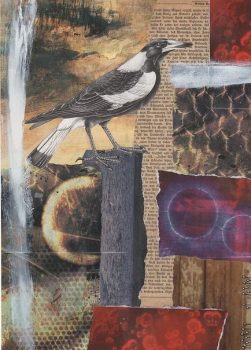
Lettera – Mark Strand

Danielle Maret

                                                   
                                                                                  for Richard Howard

Degli uomini attraversano un campo di corsa,
dalle tasche gli cadono penne.
Le raccoglierà la gente a passeggio.
È uno dei modi in cui le lettere vengono scritte.

Le cose, come cadono una nell’altra!
Il sé che non mi appartiene più, assopito
nell’ombra di un estraneo, ora veste
l’estraneo, ora lo conduce altrove.

È mezzogiorno, e ti scrivo.
La vita di non so chi mi è arrivata tra le mani.
Il sole sbianca gli edifici.
È tutto quel che ho. Lo do tutto a te. Tuo

Mark Strand

(Traduzione di Damiano Abeni con Moira Egan)

da “Più buio, 1970”, in “L’uomo che cammina un passo davanti al buio”, Mondadori, 2011

***

Letter

                                                                     for Richard Howard

Men are running across a field,
pens fall from their pockets.
People out walking will pick them up.
It is one of the ways letters are written.

How things fall to others!
The self no longer belonging to me, but asleepin
a stranger’s shadow, now clothing
the stranger, now leading him off.

It is noon as I write to you.
Someone’s life has come into my hands.
The sun whitens the buildings.
It is all I have. I give it all to you. Yours,

Mark Strand

da “Darker: poems”, Atheneum, 1970

Eternità provvisoria – Mark Strand

Claudio Bravo Camus

Claudio Bravo Camus


Un uomo e una donna stavano a letto. «Solo una volta ancora» disse l’uomo, «solo una volta ancora.» «Perché continui a ripetere la stessa cosa?» chiese la donna. «Perché non voglio che finisca mai» rispose l’uomo. «Ma cosa vuoi che non finisca?» chiese la donna. «Questo» spiegò l’uomo, «questo non volere mai che finisca.»

Mark Strand 

(Traduzione di Damiano Abeni con Moira Egan)

da “Quasi invisibile”, “Lo Specchio, I Poeti del nostro tempo”, Mondadori, 2014

∗∗∗

Provisional eternity

A man and a woman lay in bed. “Just one more time,” said the man, “just one more time.” “Why do you keep saying that?” said the woman. “Because I never want it to end,” said the man. “What don’t you want to end?” said the woman. “This,” said the man, “this never wanting it to end.”

Mark Strand

da “Almost Invisible”, Knopf, 2013

Luna – Mark Strand


Apri il libro della sera alla pagina
in cui la luna, la luna sempre, appare

tra due nuvole, spostandosi così piano che parrà
siano trascorse ore prima che tu giunga alla pagina seguente

dove la luna, ora più luminosa, fa scendere un sentiero
per condurti via da ciò che hai conosciuto

entro i luoghi in cui quello che ti eri augurato si avvera,
la sua sillaba solitaria come una frase sospesa

sull’orlo del significato, in attesa che tu ne dica il nome
una volta ancora mentre alzi gli occhi dalla pagina

e chiudi il libro, sentendo ancora com’era
soffermarsi in quella luce, quell’improvviso paradiso di suono.

Mark Strand

(Traduzione di Damiano Abeni)

da “Uomo e cammello”, “Lo Specchio” Mondadori, 2007

***

Moon

Open the book of evening to the page
where the moon, always the moon, appears

between two clouds, moving so slowly that hours
will seem to have passed before you reach the next page

where the moon, now brighter, lowers a path
to lead you away from what you have known

into those places where what you had wished for happens,
its lone syllable like a sentence poised

at the edge of sense, waiting for you to say its name
once more as you lift your eyes from the page

and close the book, still feeling what it was like
to dwell in that light, that sudden paradise of sound.

Mark Strand

da “Man and Camel”, Knopf Doubleday Publishing Group, 2008

Incendio – Mark Strand


A volte scoppiava un incendio e io ci camminavo dentro
e ne uscivo illeso e continuavo per la mia strada,
e per me era soltanto un’altra cosa fatta e finita.
Quanto a estinguere l’incendio, lo lasciavo ad altri
che si gettavano nelle nubi di fumo con ramazze
e coperte per spegnere le fiamme. Una volta finito
facevano crocchio per parlare di quello che avevano visto –
la gran fortuna di aver testimoniato i lucori del calore,
l’effetto acquietante della cenere, ma anche più di aver conosciuto il profumo
della carta che brucia, il suono delle parole che respirano la loro fine.

Mark Strand

(Traduzione di Damiano Abeni)

da “Uomo e cammello”, “Lo Specchio” Mondadori, 2007

∗∗∗

Fire

Sometimes there would be a fire and I would walk into it
and come out unharmed and continue on my way,
and for me it was just another thing to have done.
As for putting out the fire, I left that to others
who would rush into the billowing smoke with brooms
and blankets to smother the flames. When they were through
they would huddle together to talk of what they had seen –
how lucky they were to have witnessed the lusters of heat,
the hushing effect of ashes, but even more to have known the fragrance
of burning paper, the sound of words breathing their last.

Mark Strand

da “Man and Camel”, Alfred A. Knopf, 2006

Charles Webster – Edgar Lee Masters 

Nicola Bertellotti, Embrace


I boschi di pini sulla collina,
e la fattoria lontana miglia e miglia,
apparivano nitidi come dietro una lente
sotto il cielo di un azzurro pavone!
Ma una coperta di nuvole nel pomeriggio
avvolse la terra. E tu camminavi la strada
e il campo di trifogli, dove l’unica voce
era il tremolo vivo del grillo.
Poi il sole tramontò fra grandi cumuli
di lontane burrasche. Si levò un vento
e spazzò il cielo che attizzava le fiamme
delle stelle scoperte;
e faceva oscillare la luna rossiccia,
che pendeva fra l’orlo del colle
e i rami scintillanti del frutteto.
Tu camminavi soprappensiero sulla riva
dove le gole delle onde erano come civette
che cantassero sotto l’acqua e piangessero
allo sciacquío del vento in mezzo ai cedri.
Finché tu ti fermasti, troppo commossa per piangere,
e vicino alla casa, in alto, vedesti Giove,
che sfiorava la vetta del pino gigante,
e in basso vedesti la mia sedia vuota,
cullata dal vento nel portico solitario –
sii coraggiosa, Amore!

Edgar Lee Master

(Traduzione di Fernanda Pivano)

da “Spoon River Anthology”, Einaudi Editore, 1943

∗∗∗

Charles Webster

The pine woods on the hill,
And the farmhouse miles away,
Showed clear as though behind a lens
Under a sky of peacock blue!
But a blanket of cloud by afternoon
Muffled the earth. And you walked the road
And the clover field, where the only sound
Was the cricket’s liquid tremolo.
Then the sun went down between great drifts
Of distant storms. For a rising wind
Swept clean the sky and blew the flames
Of the unprotected stars;
And swayed the russet moon,
Hanging between the rim of the hill
And the twinkling boughs of the apple orchard.
You walked the shore in thought
Where the throats of the waves were like whip-poor-wills
Singing beneath the water and crying
To the wash of the wind in the cedar trees,
Till you stood, too full for tears, by the cot,
And looking up saw Jupiter,
Tipping the spire of the giant pine,
And looking down saw my vacant chair,
Rocked by the wind on the lonely porch −
Be brave, Beloved!

Edgar Lee Masters

da “Spoon River Anthology”, Mc Millan Company, New York, 1916