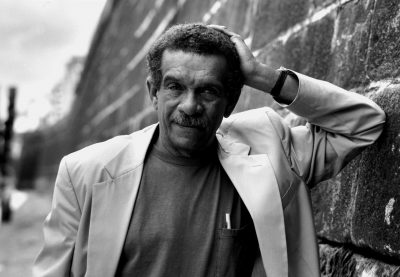
Derek Walcott
per Joseph Brodsky
I
Sulla chiara strada per Roma, oltre Mantova,
c’erano steli di riso, e ho udito, nell’eccitazione del vento,
i bruni cani del latino ansimare accanto alla macchina,
le loro ombre sfrecciavano sul ciglio in traduzione scorrevole,
oltre campi cintati da pioppi, cascine in pietra,
sostantivi da un testo di scuola, Orazio, Virgilio;
frasi di Ovidio passavano in verdi sbavature,
dirette verso prospettive di busti senza nasi,
rovine a bocca aperta e corridoi senza tetto
di Cesari il cui secondo mantello è ora fatto di polvere,
e questa voce che fruscia tra le canne è la tua.
Per ogni verso c’è un tempo e una stagione.
Tu hai ravvivato forme e strofe; questi campi rasati sono
la tua barba incolta che mi graffia la guancia alla partenza,
iridi grigie, le stoppie di grano dei tuoi capelli in aria.
Dimmi che non sei svanito, che sei sempre in Italia.
Sì. Per sempre. Dio. Per sempre immobile e muto come i campi
lombardi, come i bianchi vuoti di quella prigione,
pagine cancellate da un regime. E anche se il suo paesaggio lenisce
l’esilio tuo e di Nasone, la poesia è sempre tradimento
perché è verità. I tuoi pioppi vorticano nel sole.
II
Frullo d’ali di piccione fuori da una finestra di legno,
il fremito di un’anima agile che lascia il cuore consunto.
Il sole tocca i campanili. Clangore del Cinquecento,
nello schiaffo dell’onda attraccano e ripartono vaporetti,
lasciando l’ombra del viaggiatore sulla scena ondeggiante
a guardare il luccichio creato dal traghetto, come un pettine
tra capelli biondi che s’intrecciano al suo passaggio,
o copertine che racchiudono la schiuma dell’ultima pagina,
o qualunque sia il biancore che m’acceca coi suoi fiocchi
cancellando pini e conifere. Joseph, perché scrivo questo
se tu non puoi leggerlo? Le finestre del dorso di un libro
si aprono su un chiostro dove ogni cupola è un pretesto
per la tua anima, che come un piccione d’ardesia si libra
sull’acqua coniata e la luce ferisce come pioggia. Domenica.
I rintocchi dissennati dei campanili sono per te, che sapevi
come questa città dalle trine di pietra guarisca le nostre colpe,
simile al leone che con la zampa di ferro impedisce all’orbe
di rotolare sotto ali guardiane. Barche dal collo di violino
e ragazze dal collo di gondola erano la tua giurisdizione.
Com’è predestinato, il giorno del tuo compleanno, parlare di te a Venezia.
In questi giorni, nelle librerie, devio verso le biografie,
e la mia mano plana sui nomi con artigli aperti da piccione.
Sul mare, oltre la laguna, si chiudono parentesi
di cupole. Scesa dal traghetto, la tua ombra volta gli angoli
di un libro, si ferma in fondo a una prospettiva, e mi attende.
III
In questo paesaggio di vigne e colline hai portato un tema
che si muove fra le tue strofe inclinate, fa trasudare gli acini
e offusca le province: il lento inno nordico
della nebbia, la terra senza confini, nubi le cui forme
mutano con rabbia quando iniziamo ad associarle
a echi concreti, brecce dove l’eternità si spalanca
in una porticina azzurra. Ogni cosa solida le attende,
l’albero che diventa legna, la legna fumo del focolare,
la colomba l’eco del volo, la rima la sua eco, il tratto
dell’orizzonte che svanisce, il lavoro dei rametti
sulla pagina bianca e ciò che ricopre il loro cirillico: la neve,
il campo bianco che un corvo attraversa col suo gracchio nero,
sono una geografia distante, e non solo ora,
sei sempre stato là, la nebbia che con la zampa flessuosa
oscura il globo: sei sempre stato più felice
tra i margini freddi e incerti, non nel sole accecante
sull’acqua, in questo traghetto che si accosta alla banchina
quando un viaggiatore spegne l’ultima scintilla di una sigaretta
sotto il tacco, e il suo volto amato svanisce
in una moneta che le dita della nebbia strofinano.
IV
La schiuma al largo dello stretto mormora Montale
in sale grigio, un mare ardesia, e oltre, colline maculate
d’indaco e lilla, poi la vista dei cactus in Italia
e le palme, nomi che scintillano sull’orlo del Tirreno.
La tua eco arriva tra gli scogli, ridacchiando tra le rime
quando l’onda si frange ed è svanita per sempre!
Questi versi gettati per pesci arcobaleno o una retata di spratti,
pesci pappagallo, argentine, ballerini scarlatti,
e l’odore rancido e universale della poesia, un mare cobalto
e le palme all’aeroporto che si sorprendono da sole; ne sento l’odore,
alghe come capelli che fluttuano nell’acqua, la mica in Sicilia,
un odore più antico e più fresco delle cattedrali normanne
o degli acquedotti restaurati, le mani ruvide dei pescatori
la loro àncora di dialetti, e frasi che si seccano su muri
eretti nel muschio. Queste le sue origini, la poesia,
restano nei versi ripetuti delle onde e le loro creste,
remi e scansione, gli stormi e un unico orizzonte, chiglie
incuneate nella sabbia, la tua isola, o i versi di Montale
o Quasimodo che si dibattono come anguille in una cesta.
Sto scendendo al margine della secca per ricominciare,
Joseph, con un primo verso, una vecchia rete,
la stessa sollecitudine. Studierò l’orizzonte che si schiude,
la scansione dei colpi della pioggia, per dissolvermi
in un racconto più grande delle nostre vite, del mare, del sole.
V
Il mio colonnato di cedri fra le cui arcate l’oceano
sussurra il suo messale, ogni tronco una lettera
miniata come un breviario con frutti e viti,
lungo il quale sento l’eco incessante di un’architettura
di stanze col profilo di San Pietroburgo, i versi
di un cantore amplificato, la devozione della sua tonsura.
La prosa è lo scudiero della condotta, la poesia il cavaliere
che infilza il drago fiammeggiante con la lancia della penna,
è quasi disarcionato come un picador, ma si drizza in sella.
Accucciata sopra un foglio con la stessa postura,
una nube ripete nella sua forma il diradarsi dei tuoi capelli.
Un metro e un contegno modellati su quelli di Wystan,
strofe dal profilo romano e aperto, il busto di un Cesare minore
che allo strepito dell’arena preferisce una provincia distante,
un dovere che la polvere oscura. Sono innalzato sopra
il messale dell’onda, le colonne dei cedri, per guardare dall’alto
la cifra del mio dolore, la tua lapide, sono andato alla deriva
sopra libri di cimiteri verso un Atlantico le cui rive
si riducono, sono un’aquila che ti riporta in Russia,
stringendo fra gli artigli la ghianda del tuo cuore che ti rende,
oltre il Mar Nero di Publio Nasone, alle radici di un faggio.
Sono innalzato dal dolore e dall’elogio, così che
la tua macchia si dilati per l’esultanza, un punto che ascende.
VI
Ora, sera dopo sera dopo sera,
agosto fruscerà dalle conifere, una luce arancio
s’infiltrerà tra le pietre della strada, ombre
giacciono parallele come remi sul lungo scafo d’asfalto,
cavalli strigliati scuotono le teste in campi aridi
e la prosa esita sul ciglio del metro. La volta
si amplia, il soffitto attraversato da pipistrelli o rondini,
il cuore scala colline lilla nella luce che declina
e la grazia offusca gli occhi di un uomo che si avvicina
alla sua casa. Gli alberi serrano le porte, le onde
chiedono ascolto. La sera è un’incisione, il medaglione
di una sagoma rabbuia coloro che amiamo nel loro profilo, come il tuo,
la cui poesia trasforma il lettore in poeta. Il leone
del promontorio si trasforma come quello di San Marco, metafore
si riproducono e svolazzano nella caverna della mente,
e si sente nell’incantesimo dell’onda e nelle conifere dell’agosto,
e si legge il cirillico delle fronde che gesticolano mentre
il silenzioso consiglio dei cumuli inizia a radunarsi
su un Atlantico dalla luce calma quanto quella di uno stagno,
i lampioni spuntano come frutti nel villaggio, sopra i tetti,
e l’alveare delle costellazioni appare, sera dopo sera,
la tua voce, tra scure canne di versi che risplendono di vita.
Derek Walcott
(Traduzione di Matteo Campagnoli)
da “Prima luce”, in “Derek Walcott, Isole”, Poesie scelte (1948-2004), Adelphi, 2009
∗∗∗
31. Italian eclogues
for Joseph Brodsky
I
On the bright road to Rome, beyond Mantua,
there were reeds of rice, and I heard, in the wind’s elation,
the brown dogs of Latin panting alongside the car,
their shadows sliding on the verge in smooth translation,
past fields fenced by poplars, stone farms in character,
nouns from a schoolboy’s text, Vergilian, Horatian,
phrases from Ovid passing in a green blur,
heading towards perspectives of noseless busts,
open-mouthed ruins and roofless corridors
of Caesars whose second mantle is now the dust’s,
and this voice that rustles out of the reeds is yours.
To every line there is a time and a season.
You refreshed forms and stanzas; these cropped fields are
your stubble grating my cheeks with departure,
gray irises, your corn-wisps of hair blowing away.
Say you haven’t vanished, you’re still in Italy.
Yeah. Very still. God. Still as the turning fields
of Lombardy, still as the white wastes of that prison
like pages erased by a regime. Though his landscape heals
the exile you shared with Naso, poetry is still treason
because it is truth. Your poplars spin in the sun.
II
Whir of a pigeon’s wings outside a wooden window,
the flutter of a fresh soul discarding the exhausted heart.
Sun touches the bell-towers. Clangor of the cinquecento,
at wave-slapped landings vaporettos warp and depart
leaving the traveller’s shadow on the swaying stage
who looks at the glints of water that his ferry makes
like a comb through blond hair that plaits after its passage,
or book covers enclosing the foam of their final page,
or whatever the whiteness that blinds me with its flakes
erasing pines and conifers. Joseph, why am I writing this
when you cannot read it? The windows of a book spine open
on a courtyard where every cupola is a practice
for your soul encircling the coined water of Venice
like a slate pigeon and the light hurts like rain.
Sunday. The bells of the campaniles’ deranged tolling
for you who felt this stone-laced city healed our sins,
like the lion whose iron paw keeps our orb from rolling
under guardian wings. Craft with the necks of violins
and girls with the necks of gondolas were your province.
How ordained, on your birthday, to talk of you to Venice.
These days, in bookstores I drift towards Biography,
my hand gliding over names with a pigeon’s opening claws.
The cupolas enclose their parentheses over the sea
beyond the lagoon. Off the ferry, your shade turns the corners
of a book and stands at the end of perspective, waiting for me.
III
In this landscape of vines and hills you carried a theme
that travels across your raked stanzas, sweating the grapes
and blurring their provinces: the slow northern anthem
of fog, the country without borders, clouds whose shapes
change angrily when we begin to associate them
with substantial echoes, holes where eternity gapes
in a small blue door. All solid things await them,
the tree into kindling, the kindling to hearth-smoke,
the dove in the echo of its flight, the rhyme its echo,
the horizon’s hyphen that fades, the twigs’ handiwork
on a blank page and what smothers their cyrillics: snow,
the white field that a raven crosses with its black caw,
they are a distant geography and not only now,
you were always in them, the fog whose pliant paw
obscures the globe; you were always happier
with the cold and uncertain edges, not blinding sunlight
on water, in this ferry sidling up to the pier
when a traveller puts out the last spark of a cigarette
under his heel, and whose loved face will disappear
into a coin that the fog’s fingers rub together.
IV
The foam out on the sparkling strait muttering Montale
in gray salt, a slate sea, and beyond it flecked lilac
and indigo hills, then the sight of cactus in Italy
and palms, names glittering on the edge of the Tyrrhenian.
Your echo comes between the rocks, chuckling in fissures
when the high surf vanishes and is never seen again!
These lines flung for sprats or a catch of rainbow fishes,
the scarlet snapper, the parrot fish, argentine mullet,
and the universal rank smell of poetry, cobalt sea,
and self-surprised palms at the airport; I smell it,
weeds like hair swaying in water, mica in Sicily,
a smell older and fresher than the Norman cathedrals,
or restored aqueducts, the raw hands of fishermen
their anchor of dialect, and phrases drying on walls
based in moss. These are its origins, verse, they remain
with the repeated lines of waves and their crests, oars
and scansion, flocks and one horizon, boats with keels
wedged into sand, your own island or Quasimodo’s
or Montale’s lines wriggling like a basket of eels.
I am going down to the shallow edge to begin again,
Joseph, with a first line, with an old net, the same expedition.
I will study the opening horizon, the scansion’s strokes of the rain,
to dissolve in a fiction greater than our lives, the sea, the sun.
V
My colonnade of cedars between whose arches the ocean
drones the pages of its missal, each trunk a letter
embroidered like a breviary with fruits and vines,
down which I continue to hear an echoing architecture
of stanzas with St. Petersburg’s profile, the lines
of an amplified cantor, his tonsured devotion.
Prose is the squire of conduct, poetry the knight
who leans into the flaming dragon with a pen’s lance,
is almost unhorsed like a picador, but tilts straight
in the saddle. Crouched over paper with the same stance,
a cloud in its conduct repeats your hair-thinning shape.
A conduct whose meter and poise were modeled on Wystan’s,
a poetry whose profile was Roman and open, the bust
of a minor Caesar preferring a province of distance
to the roar of arenas, a duty obscured by dust.
I am lifted above the surf’s missal, the columned cedars,
to look down on my digit of sorrow, your stone, I have drifted
over books of cemeteries to the Atlantic whose shores
shrivel, I am an eagle bearing you towards Russia,
holding in my claws the acorn of your heart that restores
you past the Black Sea of Publius Naso
to the roots of a beech-tree; I am lifted with grief and praise, so
that your speck widens with elation, a dot that soars.
VI
Now evening after evening after evening,
August will rustle from the conifers, an orange light
will seep through the stones of the causeway, shadows
lie parallel as oars across the long hull of asphalt,
the heads of burnished horses shake in parched meadows
and prose hesitates on the verge of meter. The vault
increases, its ceiling crossed by bats or swallows,
the heart climbs lilac hills in the light’s declension,
and grace dims the eyes of a man nearing his own house.
The trees close their doors, and the surf demands attention.
Evening is an engraving, a silhouette’s medallion
darkens loved ones in their profile, like yours,
whose poetry transforms reader into poet. The lion
of the headland darkens like St. Mark’s, metaphors
breed and flit in the cave of the mind, and one hears
in the waves’ incantation and the August conifers,
and reads the ornate cyrillics of gesturing fronds
as the silent council of cumuli begins convening
over an Atlantic whose light is as calm as a pond’s
and lamps bud like fruit in the village, above roofs, and the hive
of constellations appears, evening after evening,
your voice, through the dark reeds of lines that shine with life.
Derek Walcott
da “The Bounty: Poems”, Farrar, Straus and Giroux, 1998





 Poesia in rete