«Più luce! più luce!» – Anthony Hecht

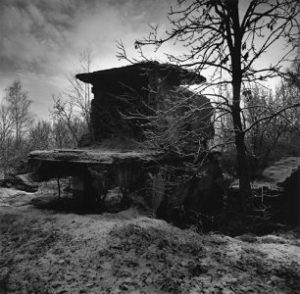
Michael Kenna, Building Remains, Buchenwald, Germany, 1995

per Heinrich Blücher e Hannah Arendt

Composti nella Torre prima della sua esecuzione
questi versi commoventi, condotto allora sul tragitto
penoso verso il rogo, sottomesso, dichiarò:
«Invoco il mio Dio a testimone, non ho commesso alcun delitto».

Né lo abbandonò il coraggio, ma la morte fu tremenda,
il sacco di polvere da sparo non si accendeva.
Le gambe, mentre lui implorava urlante la Luce Misericordiosa,
erano bastoni di vesciche su cui la linfa nera ribolliva ed esplodeva.

E quello non fu che uno, e niente affatto dei peggiori,
concessagli almeno la sua commiserevole dignità;
e gli astanti recitavano preghiere per la pace dell’anima sua,
nel nome di Cristo che ciascun uomo giudicherà.

Ci spostiamo adesso al limitare di un bosco tedesco.
Si ordina di scavare una fossa a tre uomini tenuti in scacco,
e in questa viene ordinato ai due ebrei di sdraiarsi
per essere sepolti vivi dal terzo, un polacco.

Non luce dal santuario a Weimar oltre la collina
né luce dal cielo apparve. Ma egli si rifiutò.
Una Lüger s’assestò nella fondina.
Scàmbiati di posto con gli ebrei, gli si ordinò.

Quella sovrabbondanza di morte insensata ne aveva prosciugato
l’anima. La terra spessa montava verso la faccia sconvolta.
Quando solo la testa restò esposta, arrivò l’ordine
di tirarlo fuori e di tornare dentro un’altra volta.

Nessuna luce, nessuna luce nel ceruleo occhio polacco.
Quando finì, uno stivale da cavallo pressò la terra forte.
La Lüger si librò leggera dalla fondina.
Colpito in pancia, in tre ore sanguinò a morte.

Non una preghiera, niente incenso, s’alzò in quelle ore
che divennero anni; e venivano ogni sera
muti spettri dai forni, filtrando nell’aria frizzante,
posandosi sui suoi occhi come fuliggine nera.

Anthony Hecht

(Traduzione di Damiano Abeni e Moira Egan)

da “Le ore dure”, Donzelli Poesia, 2018

«Più luce! Più luce!»
Hecht ha scritto in una lettera che il titolo riprende le parole attribuite a Goethe sul letto di morte. Le spoglie di Goethe si trovano nella Cripta dei Principi a Weimar, vicino al luogo in cui è sorto il campo di sterminio di Buchenwald. La prima parte della poesia è un collage di particolari che si riferiscono al supplizio di diversi martiri rinascimentali, tra cui Hugh Latimer e Nicholas Ridley. L’episodio finale, ambientato nel campo di sterminio, viene dal volume The Theory and Practice of Hell di Eugen Kogon.

∗∗∗

«More Light! More Light!»

for Heinrich Blücher and Hannah Arendt

Composed in the Tower before his execution
These moving verses, and being brought at that time
Painfully to the stake, submitted, declaring thus:
“I implore my God to witness that I have made no crime.”

Nor was he forsaken of courage, but the death was horrible,
The sack of gunpowder failing to ignite.
His legs were blistered sticks on which the black sap
Bubbled and burst as he howled for the Kindly Light.

And that was but one, and by no means one of the worst;
Permitted at least his pitiful dignity;
And such as were by made prayers in the name of Christ,
That shall judge all men, for his soul’s tranquillity.

We move now to outside a German wood.
Three men are there commanded to dig a hole
In which the two Jews are ordered to lie down
And be buried alive by the third, who is a Pole.

Not light from the shrine at Weimar beyond the hill
Nor light from heaven appeared. But he did refuse.
A Lüger settled back deeply in its glove.
He was ordered to change places with the Jews.

Much casual death had drained away their souls.
The thick dirt mounted toward the quivering chin.
When only the head was exposed the order came
To dig him out again and to get back in.

No light, no light in the blue Polish eye.
When he finished a riding boot packed down the earth.
The Lüger hovered lightly in its glove.
He was shot in the belly and in three hours bled to death.

No prayers or incense rose up in those hours
Which grew to be years, and every day came mute
Ghosts from the ovens, sifting through crisp air,
And settled upon his eyes in a black soot.

Anthony Hecht

da “The hard hours: poems”, Atheneum, 1967

Una lettera – Anthony Hecht


                    Da un po’ mi sto chiedendo
a cosa pensi, e a questo punto mi sa
                    non a me, certamente.
Ma s’è destato il croco, e l’allodola, e il tremebondo
                    sangue sa quello che sa.
Parla da solo tutta notte, come un mare di luna semovente.

                   Certo, è di te che parla.
All’alba, su cui l’oceano ha issato il suo strascico di lumi,
                   il sole pianta un piede flessuoso
su quello scroscio di specchi, ma il sangue tarla
                   le tiepide notti d’Arabia,
pronunciando il tuo nome pulsante nelle buie radici del cuore.

                   Nome che, certo, resterà innominato.
Comunque, voglio tu sappia che ho fatto del mio meglio,
                   come son sicuro hai fatto anche tu.
Qualcun altro è legato a noi, incolpevole e garbato,
                   il cui nome sta nel garbuglio
delle ciance incessanti. Carissima, il limpido, insepolto blu

                   di quegli abissi è quasi accecante.
Forse ricordi la volta che portasti ai miei fanciulli
                   due uccelletti lanuti.
Ieri il primo mi ha chiesto di te – aveva ritrovato
                   il tuo piccolo tordo tra i suoi trastulli.
E le maree sono montate attorno a me, e sono rimasto muto.

                   C’è poco altro da raccontare.
Si dà il proprio meglio per continuare come in passato,
                   facendo qualche buona azione.
Ma vorrei che tu sapessi che non va tutto bene
                  quando un uomo è ferreo nella negazione
delle interminabili ripetizioni del proprio sangue sussurrato.

Anthony Hecht

(Traduzione di Damiano Abeni e Moira Egan)

da “Le ore dure”, Donzelli Poesia, 2018

∗∗∗

A Letter

                    I have been wondering
What you are thinking about, and by now suppose
                    It is certainly not me.
But the crocus is up, and the lark, and the blundering
                    Blood knows what it knows.
It talks to itself all night, like a sliding moonlit sea.

                   Of course, it is talking of you.
At dawn, where the ocean has netted its catch of lights,
                   The sun plants one lithe foot
On that spill of mirrors, but the blood goes worming through
                   Its warm Arabian nights,
Naming your pounding name again in the dark heart-root,

                   Who shall, of course, be nameless.
Anyway, I should want you to know I have done my best,
                   As I’m sure you have, too.
Others are bound to us, the gentle and blameless
                   Whose names are not confessed
In the ceaseless palaver. My dearest, the clear unquarried blue

                   Of those depths is all but blinding.
You may remember that once you brought my boys
                   Two little woolly birds.
Yesterday the older one asked for you upon finding
                   Your thrush among his toys.
And the tides welled about me, and I could find no words.

                   There is not much else to tell.
One tries one’s best to continue as before,
                   Doing some little good.
But I would have you know that all is not well
                   With a man dead set to ignore
The endless repetitions of his own murmurous blood.

Anthony Hecht

da “The hard hours: poems”, Atheneum, 1967
Una collina – Anthony Hecht

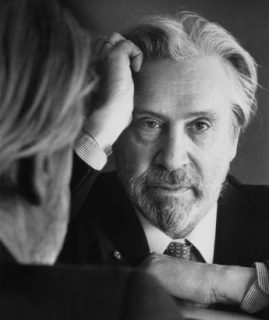
Foto di Bruno La Pietra


In Italia, dove cose così sanno accadere,
una volta ho avuto una visione – ma, capirete,
in nulla come quelle di Dante, o dei santi,
forse per niente una visione. Con amici
procedevo adagio in una piazza calda di sole,
di primo mattino. Una radiosa tarsia d’ombre
dagli ombrelloni si spargeva sul selciato, faceva
lucenti bassifondi dove una flottiglia
di carri era ormeggiata. Libri, monete, mappe
antiche, paesaggi da due soldi, orribili stampe
religiose erano in vendita. I colori, i rumori,
come le mani in volo, erano gesti di giubilo,
così che anche le contrattazioni
giungevano all’orecchio come volubile religiosità.
Poi, quando accadde, i rumori caddero improvvisi,
si fece scuro; svanirono carretti e gente
e perfino l’imponente Palazzo Farnese
era scomparso, con tutti i suoi marmi; al suo posto
una collina color topo e brulla. Faceva assai freddo,
quasi gelava, e prometteva neve.
Gli alberi erano ferrivecchi affastellati
contro un muro d’officina. Niente vento,
e il solo suono per un po’ fu lo scrocchiare fino
del ghiaccio rotto nel fango dal mio passo.
Vidi una striscia di tela impigliata a una siepe,
non altro segno di vita. E poi udii
come lo schiocco di una schioppettata. Un cacciatore,
pensai; almeno non sono solo. Ma subito
seguì il soffice schianto cartaceo
di un grosso ramo che crollava a terra non visto.

Fu tutto, se non per il gelo e il silenzio
che promettevano di durare in eterno, come la collina.

Anthony Hecht

(Traduzione di Damiano Abeni e Moira Egan)

da “Le ore dure”, Donzelli Poesia, 2018

∗∗∗

A Hill

In Italy, where this sort of thing can occur,
I had a vision once-though you understand
It was nothing at all like Dante’s, or the visions of saints,
And perhaps not a vision at all. I was with some friends,
Picking my way through a warm sunlit piazza
In the early morning. A clear fretwork of shadows
From huge umbrellas littered the pavement and made
A sort of lucent shallows in which was moored
A small navy of carts. Books, coins, old maps,
Cheap landscapes and ugly religious prints
Were all on sale. The colors and noise
Like the flying hands were gestures of exultation,
So that even the bargaining
Rose to the ear like a voluble godliness.
And then, when it happened, the noises suddenly stopped,
And it got darker; pushcarts and people dissolved
And even the great Farnese Palace itself
Was gone, for all its marble; in its place
Was a hill, mole-colored and bare. It was very cold,
Close to freezing, with a promise of snow.
The trees were like old ironwork gathered for scrap
Outside a factory wall. There was no wind,
And the only sound for a while was the little click
Of ice as it broke in the mud under my feet.
I saw a piece of ribbon snagged on a hedge,
But no other sign of life. And then I heard
What seemed the crack of a rifle. A hunter, I guessed;
At least I was not alone. But just after that
Came the soft and papery crash
Of a great branch somewhere unseen falling to earth.

And that was all, except for the cold and silence
That promised to last forever, like the hill.

Anthony Hecht

da “The hard hours: poems”, Atheneum, 1967